

TL;DR
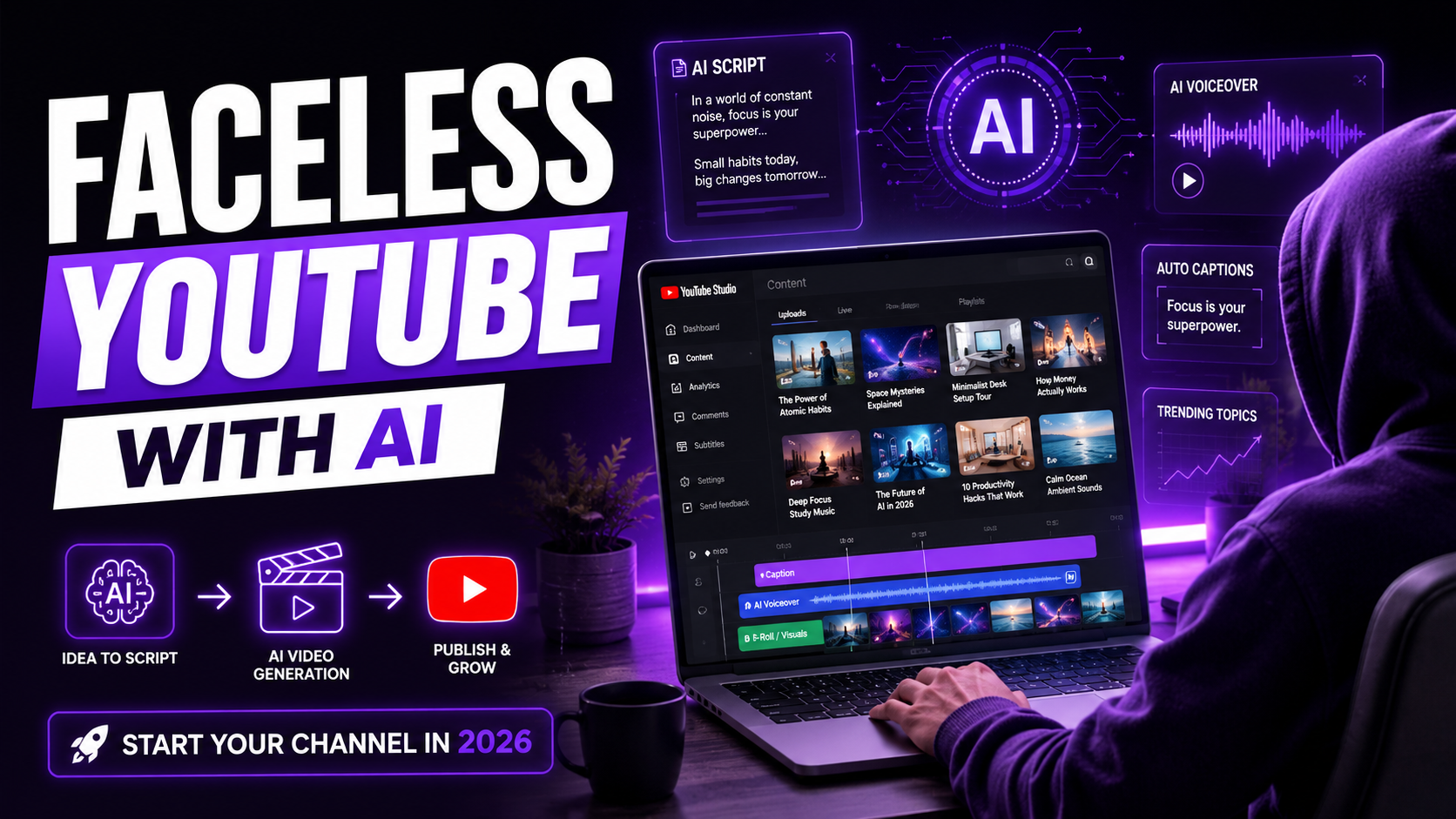
A faceless YouTube channel publishes without the creator ever appearing on camera. AI tools handle the scripting, voiceover, visuals, and captions. Pictory converts a text script into a publish-ready YouTube video in minutes. This guide covers niche selection, the production workflow, YouTube’s monetisation rules for AI content, and how to build a consistent publishing cadence without burning out.
You don’t need to appear on camera to build a successful YouTube channel. Faceless channels covering topics like personal finance, history, technology, and productivity consistently generate millions of views, and they’re produced entirely using AI voiceovers, stock footage, and text-to-video tools. Pictory’s Script to Video workflow handles the entire production in one place.
This guide covers how to build a faceless channel that produces genuinely useful content, and how to do it at a pace that’s actually sustainable.

What is a faceless YouTube channel and why do they work?
A faceless YouTube channel is one where the creator never appears on screen. Content is produced using voiceovers, stock footage, animations, AI-generated visuals, or screen recordings. The focus is entirely on the information or entertainment — not the presenter.
They work because YouTube’s algorithm doesn’t care if you’re on camera. It cares about watch time, click-through rate, and whether viewers stick around. A well-scripted faceless video beats a poorly-structured talking-head one every time.
62% of video makers in 2025 were individuals at companies creating content without a dedicated production team. Wyzowl, 2026 — faceless production is now the default, not the exception.
What niches work best for faceless AI YouTube channels?
The strongest niches for faceless channels are topics where information and clarity matter more than personality. Here’s what’s consistently working.
Personal finance and investing
High CPM, evergreen content, strong search volume. Viewers want data and explanations, not a personality.
History and documentary
Archive footage, narration, and visual storytelling. Well-produced narration over archival content performs exceptionally well.
How-to and tutorials
Screen recordings and step-by-step walkthroughs. No camera needed — your screen is the content. Highly searchable.
Business and marketing content
Marketing statistics, case studies, strategy explainers. Pairs naturally with Pictory’s Script to Video workflow.
The AI production workflow for faceless YouTube videos
This five-step workflow takes you from blank page to published YouTube video. For a deeper walkthrough of the script-to-video process, see the Pictory Academy guide to turning a script into a video.
Research and script
Identify a specific question your audience is searching for. Write a focused script covering one idea well. Use Pictory’s AI Script Generator for a first draft, then edit for accuracy and personality. 600 to 900 words gives you a five to seven minute video.
Generate video with Pictory
Paste your script into Script to Video. Pictory matches each paragraph to stock footage from Getty Images and Storyblocks, adds your AI voiceover, and produces a first cut automatically.
Review and swap footage
Check each scene and replace any clips that don’t fit. This is where your judgment earns its keep. The AI picks based on keywords; you pick based on what actually works. Typically takes 10 to 15 minutes.
Add captions and music
Captions are auto-generated. Add background music from Pictory’s licensed audio library. Captions are essential: see how to add captions to your video automatically — most YouTube viewers watch without sound at least some of the time.
Export and upload to YouTube
Download in 1080p and upload directly to YouTube Studio. Write a keyword-rich title and description. Total production time per video: 45 to 90 minutes once you’re familiar with the workflow. For platform-specific export settings, the Pictory Academy guide to creating platform-specific videos covers the exact settings for YouTube, Shorts, and social.
YouTube’s 2026 rules on AI-generated faceless content
This is the question every faceless creator is asking. YouTube’s position has evolved significantly. In July 2025, YouTube renamed its “repetitious content” policy to “inauthentic content” and made enforcement substantially stricter. A wave of enforcement in January 2026 removed thousands of channels.
What YouTube is targeting is content that looks mass-produced, template-driven, or machine-generated without meaningful human creative input. It’s not AI tools it’s concerned with — it’s content with no original perspective, no editorial judgment, and no value beyond filling a quota.
What YouTube requires for monetisation eligibility on AI content:
- Original commentary, research, or perspective — not just rephrased facts
- Meaningful creative decisions in scripting, editing, and visual selection
- Disclosure when content is “significantly altered or synthetic” in description or via the AI label tool
- Consistent value to the viewer, not volume for its own sake
Pictory-produced videos that meet these criteria perform well on YouTube. The tool handles production — the human creator still needs to supply the original thinking, the research, and the editorial choices that make each video worth watching.
Start your faceless YouTube channel with Pictory
Script to video in one workflow. No camera, no filming, no editing expertise required.
Is a faceless AI YouTube channel worth building in 2026?
Yes, if you approach it correctly. The channels succeeding in 2026 are not the ones pumping out the most videos — they are the ones producing the most useful videos for a specific audience. AI tools make that possible without a camera, a studio, or a production team. The production barrier is gone. What remains is the same thing it has always been: original thinking, consistent publishing, and content that is actually worth watching.
Pictory handles the entire production side of that equation. You write the script or paste in your content, and the platform builds a finished, branded, captioned YouTube video from it. For creators who have spent hours on video editing in the past, the time saving is significant. For creators who have never made a video at all, the barrier to starting has never been lower.
If you are ready to start, the free trial gives you access to the full Script to Video workflow with no credit card required. Build your first video, see how the process works, and decide from there.
Ready to build your faceless YouTube channel?
Start with your first script. Pictory turns it into a publish-ready video in minutes.
FAQ: Faceless YouTube Channel with AI
Can you make money from a faceless YouTube channel in 2026?
Yes, but you need to meet YouTube’s requirements. Faceless AI channels qualify for monetisation when they contain original editorial perspective, meaningful creative decisions, and genuine value for viewers. Template-driven, mass-produced content without original input is increasingly being penalised or demonetised under YouTube’s inauthentic content policy updated in 2025.
What AI tools do you need to run a faceless YouTube channel?
The core workflow requires a script generator, a text-to-video tool, and an AI voiceover. Pictory covers all three — you can generate your script with Pictory’s built-in AI, match it to stock footage automatically, and add a professional AI voiceover without leaving the platform.
How long does it take to produce a faceless YouTube video with AI?
For a five to seven minute video, expect 45 to 90 minutes of production time once you’re familiar with the workflow. Research and scripting takes 20 to 30 minutes. Video generation and review takes 20 to 40 minutes. Export and upload takes five to ten minutes.
Does Pictory work for faceless YouTube content?
Yes. Pictory converts text scripts into YouTube-ready videos with stock footage, AI voiceovers, and auto-captions. It is built for exactly the kind of text-to-video workflow that faceless YouTube creators need. Paste your script into Script to Video and Pictory builds a finished, branded video automatically.
What are the best niches for faceless AI YouTube channels?
Personal finance, history, technology explainers, business strategy, marketing, and how-to tutorials consistently perform well for faceless channels. Look for topics with strong search volume where information and clarity matter more than personality, and where you can genuinely contribute original research or perspective.

![[Article] - AI UGC: User-Generated-Style Ads Without Creators](https://pictory.ai/wp-content/uploads/2026/08/blog-ai-ugc-300x169.webp)