

TL;DR
The strongest OpusClip alternatives in 2026 are Pictory, Vizard, Klap, Submagic, Descript, Kapwing, quso.ai, and CapCut. Pictory fits B2B marketing and learning teams turning webinars, podcasts, and Zoom recordings into branded short clips at scale. Vizard suits solo podcasters, Klap wins on visual polish, and CapCut is the top free choice for teams comfortable editing manually.
OpusClip turned viral short-form clips into a one-click job, but you’re now paying by the minute of source video. Upload a 90-minute podcast and that’s 90 credits gone before you’ve picked a single clip. Between credit expiration windows, watermark limits on free exports, and processing slowdowns reported through 2026, teams are shopping alternatives. Here are the eight best OpusClip alternatives worth testing this year, ranked for the workflows real teams run.
Why teams are shopping OpusClip alternatives in 2026
OpusClip runs on a credit system where one credit equals one minute of source video, not the number of clips you generate. Upload a 45-minute podcast, and that costs 45 credits whether you keep three clips or 20. The Starter plan at $15 per month includes 150 credits according to OpusClip. That’s less than four hours of source processing before you’re capped.
Credit expiration is the second friction point. OpusClip’s own pricing page confirms that monthly plan credits expire after 60 days and annual credits expire after 12 months. If your production month is quiet, credits don’t roll forward the way you’d expect.
The free plan applies a watermark and a three-day export window, which rules it out for professional publishing. And review sites tracking OpusClip through 2026 report processing slowdowns and refund friction that show up repeatedly in its Trustpilot reviews. For teams running the volume, the math on switching starts to make sense.
One credit equals one minute of source video. A 90-minute webinar costs 90 credits before you pick a single clip. Source: opus.pro/pricing
How we tested each OpusClip alternative
Every tool below was tested on the same source file: a 45-minute B2B marketing podcast recording, uploaded through each platform’s standard workflow. We rated each on AI clip detection quality, caption styling depth, brand kit control, aspect ratio flexibility (16:9, 9:16, 1:1), pricing structure (per-minute versus per-video versus per-project), and free tier honesty. Pricing was verified against each tool’s own pricing page in July 2026.
Full disclosure: we make Pictory. We’ve placed it at number one because the workflow matches the use case we specialize in, but every tool on this list has real strengths. Where a competitor leads, we’ve said so.
OpusClip alternatives at a glance
Eight tools, four categories. Two cover the full clipping-plus-creation workflow (Pictory, Descript). Three focus on AI-generated clips for creators (Vizard, Klap, Submagic). One folds clipping into an all-in-one publisher (quso.ai). Two anchor the free and low-cost end (Kapwing, CapCut).
| Tool | Best for | Pricing model | Brand kit |
|---|---|---|---|
| Pictory | B2B marketing and learning teams | Per-project, tiered plans | Yes, team-shared |
| Vizard | Solo podcasters | Minute-based | Yes |
| Klap | Polished visual style | Tiered plans | Limited |
| Submagic | Animated captions | Tiered plans | Limited |
| Descript | Text-based podcast editing | Tiered plans | Yes |
| Kapwing | Free web-based clipping | Freemium | Yes, on paid |
| quso.ai | All-in-one with scheduling | Minute-based | Yes |
| CapCut | Free manual editing | Freemium | Yes, on Pro |
Pricing details verified against each tool’s pricing page in July 2026. Check the source page before you subscribe.
1. Pictory: Best OpusClip alternative for marketing and learning teams
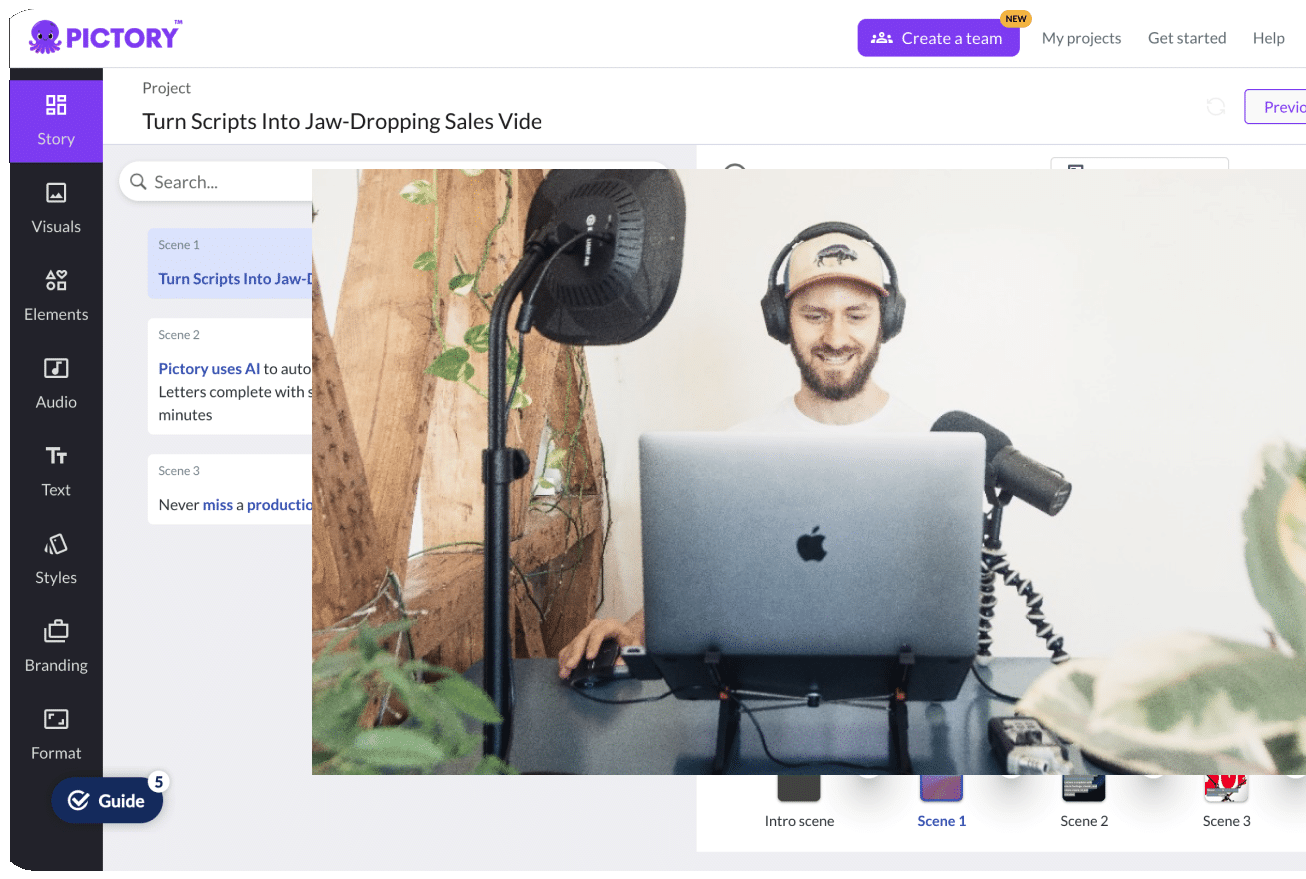
Pictory turns long recordings into short branded clips through its Summarize Video feature, with clip lengths of 30 seconds, 1 minute, 2 minutes, or 5 minutes. Upload a webinar, podcast, or Zoom recording, and Pictory transcribes it, identifies the strongest sentences, removes filler words and silences, and produces a captioned clip. You pick the sentences that make the summary; the AI handles the rest.
The workflow does more than clip. Pictory ships 170+ AI voiceovers, custom voice cloning, and AI avatars in the same interface. If you want to add a talking-head presenter to your clip, drop in an AI avatar or your own cloned voice from the Audio and Avatars tabs. Multilingual output covers repurposing across regions, and every project stores in your Team workspace for review.
What it’s not: Pictory doesn’t publish natively to TikTok or Instagram from the app the way OpusClip Pro does. If day-one native scheduling matters more than brand consistency, look at quso.ai or Choppity instead. And Pictory’s video generation focus means it fits marketing, sales enablement, and L&D teams better than pure creator workflows.
Pricing: Pictory offers Starter, Professional, and Teams plans plus Enterprise pricing. Plans are structured around video minutes and features rather than per-source-minute credits. See current Pictory plans for exact tiers.
Read our full guide to repurposing long-form video into shorts for the workflow in detail.
2. Vizard: Best for solo podcasters and talking-head video
Vizard turns one long video into 10 or more short clips automatically, with a cleaner interface than OpusClip for solo creators. The AI clip detection is solid for podcasts and interview-style content, and the caption styling is competent out of the box. It’s the closest one-for-one OpusClip replacement in feel.
Where it lags: brand kit control is thinner than Pictory or Descript, and team workflows are less developed. If you’re a single creator running one channel, that won’t matter. If you’re managing five client brands, it will. Pricing is minute-based, and the free tier applies a watermark. Check the current tiers on vizard.ai/pricing.
3. Klap: Best for polished visual style on short-form clips
Klap pushes visual polish harder than most tools in this category. The caption animation library is strong, the visual presets look genuinely finished, and the exports feel closer to hand-edited than auto-generated. If your team cares about how the finished clip looks and not just how fast it lands, Klap earns its place.
The trade-off: fewer input formats and no native scheduling. Klap focuses on clip generation and stops there. If you need clipping plus scheduling plus analytics in one tool, look at quso.ai. Pricing tiers and free-tier limits shift regularly, so verify current plans on klap.app/pricing.
4. Submagic: Best for animated captions and B-roll overlays
Submagic is where you go for the deepest caption styling control in this list. Animated word-by-word reveals, keyword highlights, custom fonts, and B-roll overlays that trigger on transcribed keywords: it’s the tool built for creators who treat captions as a design element, not an accessibility checkbox.
It’s less useful if you need one tool to handle the whole workflow. Submagic is purpose-built for clips, so full video production, brand-shared templates, and scheduling live elsewhere in your stack. Best if you’re already using another tool for the source video and just want the caption layer polished. Check submagic.co/pricing for current tiers.
5. Descript: Best for text-based podcast editing
Descript edits video the way a writer edits a document. Delete a sentence in the transcript, and the video cuts to match. For podcasters and long-form interviewers who think about content in words rather than timelines, it’s the most native workflow on the market. The clip export is a feature layered on top of that editing model, not the core.
Overkill if you only need clips. Descript’s learning curve is meaningful, and the pricing reflects the broader feature set (studio recording, overdub, screen capture, transcription). If you’re clipping podcast content weekly and want to edit like a document, it fits. If you’re clipping to volume, Pictory or Vizard costs less time and less money. Current plans at descript.com/pricing.
6. Kapwing: Best free web-based clipper
Kapwing has one of the strongest free tiers with AI-assisted clipping, though free exports carry a watermark. It runs in the browser with no install, and the interface is one of the most approachable for teams that don’t have a dedicated video editor. AI clip detection works, though it’s less precise than Vizard or Klap on long podcasts.
Where it falls short: automation is thinner than dedicated AI clippers, and paid tiers are needed for team collaboration and brand kits. Good for zero-budget testing and light usage. See kapwing.com/pricing for the current freemium terms.
7. quso.ai: Best all-in-one with native social scheduling
quso.ai matches OpusClip’s AI clipping and virality scoring, then folds a full social scheduler and analytics dashboard into the same subscription. According to quso.ai’s pricing page, the free plan includes 75 credits a month with no watermark, which is more generous than OpusClip’s free tier at 60 credits with a watermark.
The pitch is one subscription replacing four or five tools. That works for solo creators and small agencies. For enterprise-grade team workflows or L&D use cases, Pictory or Descript will fit better. Check paid tiers directly on quso.ai for the current pricing.
8. CapCut: Best free option for teams comfortable editing manually
CapCut is the free tier the rest of the market gets compared against. It has no AI clip detection, so you scrub the timeline and pick clips manually. In exchange, you get a genuinely free tool with no watermark on standard exports, a strong template library, and cross-device sync between desktop and mobile.
The right pick if you have time and no budget. The wrong pick if you’re clipping five webinars a week and need the AI to do the first pass. CapCut Pro adds premium assets, but the workflow model doesn’t change. Pair it with Vizard for AI moment detection if that’s the gap you’re trying to fill.
How do you pick the right OpusClip alternative for your team?
Start with volume and use case, not features. If you’re burning through 300 credits a month on OpusClip Pro, per-minute pricing is your enemy: move to a per-video or per-project model. If you need one tool for clipping and video creation, Pictory covers both workflows. Here’s the decision matrix in one view.
Try turning your next webinar into clips
Upload a recording, pick your summary length, and export branded shorts in minutes.
When Pictory is the right fit (and when it isn’t)
Pictory fits best if you’re a B2B marketing team repurposing webinars for LinkedIn, a sales enablement team building product demo clips, an L&D team turning training recordings into course modules, or an agency managing multiple client brands through shared Brand Kits. The podcast repurposing workflow covers most of what OpusClip does, then adds full video creation from scripts, blog posts, URLs, and PowerPoints.
Pictory isn’t the right fit if you’re a solo TikTok creator hunting for viral hooks (Vizard or Klap fit closer), if day-one native scheduling to TikTok and Instagram from inside the app matters more than brand consistency (quso.ai or Choppity lead there), or if your workflow is text-first document editing (Descript is built for that model).
The recommendation: if the pain point that brought you here is per-minute credit spend and brand consistency across a team, Pictory pays back the switch within a month. Start with a free trial, upload a real webinar, and see how the Summarize Video flow handles your actual content.
Test Pictory on your next long recording
Fast, scalable, affordable video repurposing. No credit card. No watermark on paid exports.
Frequently Asked Questions
Is OpusClip worth it in 2026?
OpusClip is worth it if you want a clipping-only tool and process under 300 minutes of source video a month. The per-minute credit system gets expensive on long podcasts because one credit equals one minute of source video, and monthly credits expire in 60 days. Heavy users often switch to per-video or per-project pricing models.
What is the best free alternative to OpusClip?
CapCut is the strongest free OpusClip alternative for manual editing, though it has no AI clip detection. Pictory and Kapwing both offer free trials with AI-powered clipping so you can test before you subscribe. Most free tiers apply watermarks to exports, so check the terms before you publish clips to social.
Which OpusClip alternative is best for repurposing webinars?
Pictory is the strongest OpusClip alternative for webinars. It summarizes long recordings into short clips, removes filler words and silences, and applies your brand kit across every export. You can pick clip lengths from 30 seconds to 5 minutes and publish in 16:9, 9:16, or 1:1 from the same project without re-editing.
What’s the difference between OpusClip and Pictory?
OpusClip focuses on AI-generated viral clips from long videos, mainly for creators and podcasters. Pictory covers the same clipping workflow through its Summarize Video feature, plus full video creation from scripts, blog posts, URLs, PowerPoint, and PDF. It targets B2B marketing, sales enablement, and learning teams rather than solo creators.
Can I use OpusClip alternatives without editing skills?
Yes. Every AI-powered tool on this list, including Pictory, Vizard, Klap, and Submagic, uses AI to find highlights, add captions, and reframe clips for each platform. Your job is picking the clips and adjusting the brand look. No editing background is needed to produce polished, publish-ready short videos.
Keep reading
Turn long recordings into short clips step-by-step.
The highlights workflow inside Pictory, explained.
Turn podcast episodes into branded video for LinkedIn and YouTube.