

KEY FINDINGS AT A GLANCE
- The peak hour for AI video creation globally is 9pm local time — most creators build content after work, not during it.
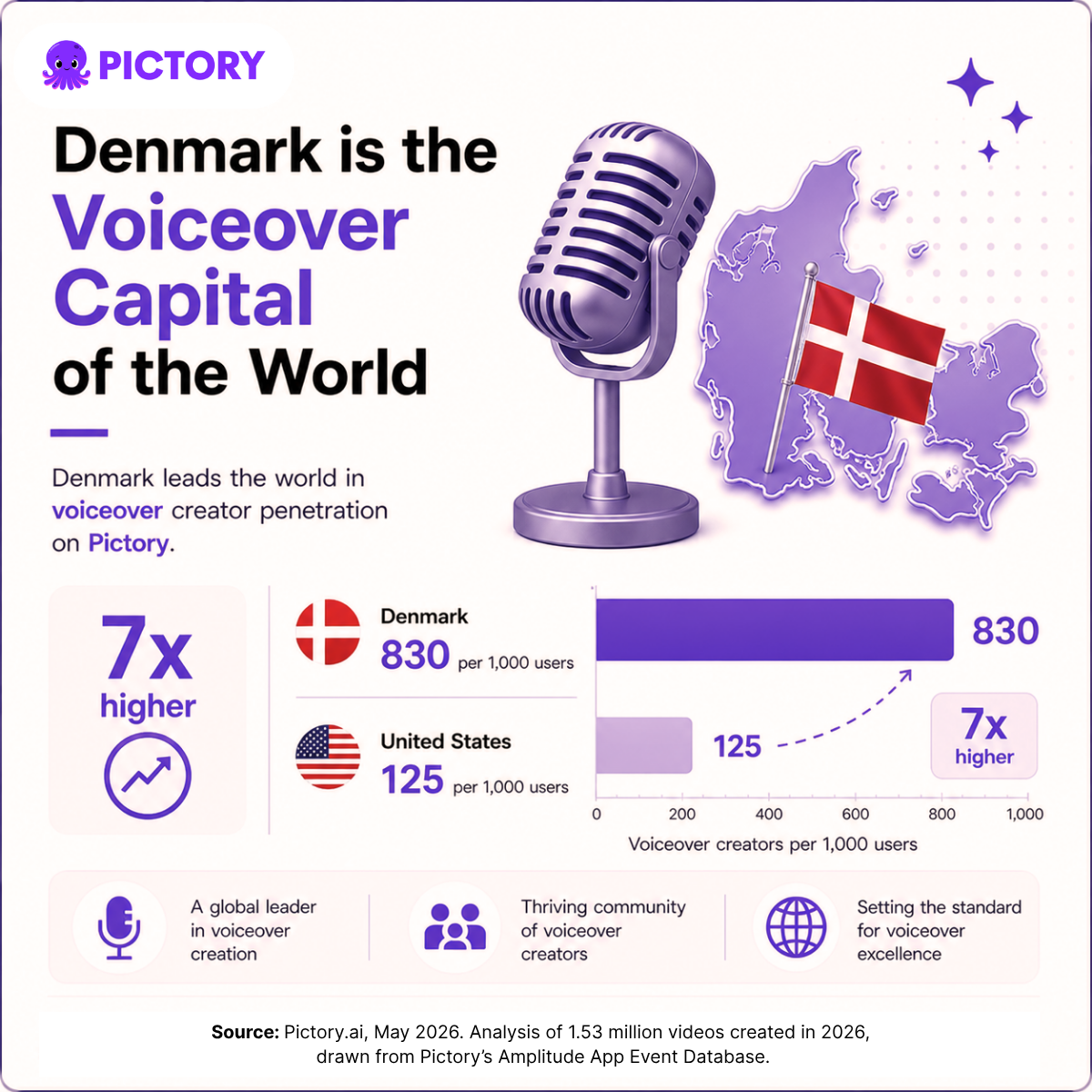
- Denmark leads the world in voiceover adoption at nearly 7x the US rate. Small markets are setting the quality standard.
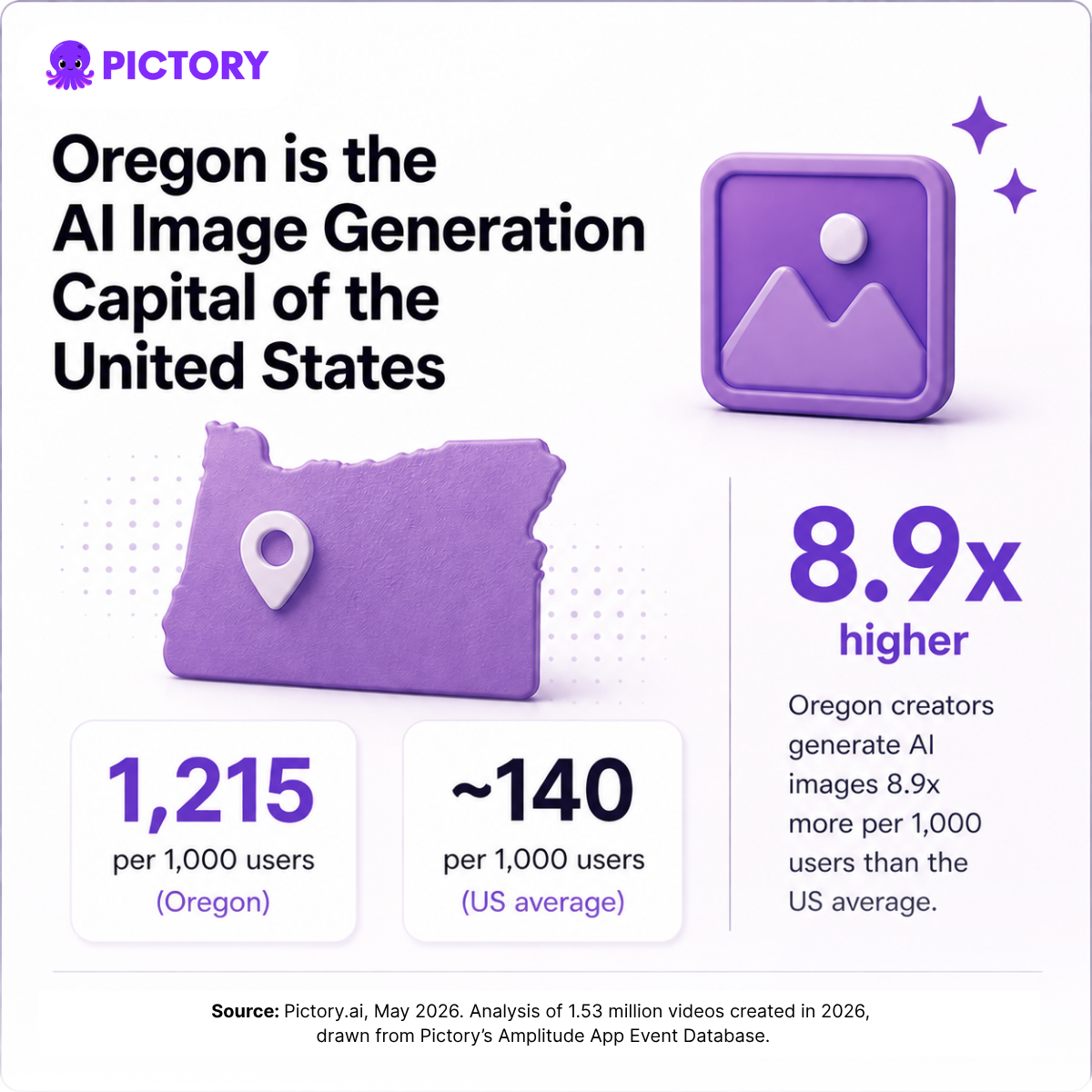
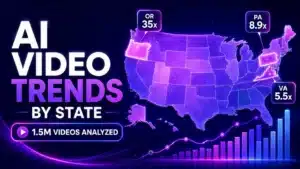
- Oregon generates AI images at 9x the US average. Pennsylvania leads the US in AI avatar usage at 4x California's rate.
- Professional users create URL-to-video content at 9x the rate of personal users — repurposing is now a core business workflow.
- YouTube creators produce the longest videos at 3.9 minutes. Sales and marketing teams keep it shortest at 1.7 minutes.
- Mac users upload voiceovers at 75% higher rates than Windows users and generate AI images at 45% more.
Introduction
AI video-creation is rapidly shifting from a niche capability to a mainstream content workflow. To understand how creators are actually using AI video tools, Pictory analyzed behavioral data from more than 1.5 million videos created in 2026 on its platform.
This report surfaces global patterns in how individuals, businesses, and creators are producing video content, highlighting differences across regions, roles, devices, and workflows.
The findings reveal a clear shift toward scalable, AI-assisted video production, with distinct behavioral trends emerging across markets and use cases.
This report is based on aggregated, anonymized usage data from over 1.5 million videos created in 2026 using Pictory.
The analysis includes:
Global users across multiple countries and regions
Behavioral data across workflows (text-to-video, URL-to-video, audio-to-video, etc.)
Feature usage (AI avatars, voiceovers, background music, AI image generation)
Creator segments (YouTube, Sales & Marketing, Training/Education, Employee Communications)
Device usage patterns (Mac, Windows, mobile)
All metrics are normalized per 1,000 users unless otherwise stated.
Key Findings
Creators are night owls: The global peak time for AI video-creation is 9pm local time, indicating that most creators build content outside traditional working hours.
The small but mighty (global leader): Denmark leads the world in voiceover adoption, with usage rates nearly 7x higher than the United States.
Regional centers stake their claim in the US: Oregon is the top US state for AI image generation, producing nearly 9x the national average and Pennsylvania leads the US in AI avatar usage, with adoption rates 4x higher than California. And Florida stands out as the most creatively balanced state in the US. Ranking in the Top 3 nationally for AI image generation, avatar usage, audio-to-video, and background music, Florida creators represent an experimental philosophy that utilizes the full breadth of the AI toolkit rather than specializing in a single niche.
Educators and trainers use PPT… A LOT: Trainers and educators use PPT-to-video conversion at 4x the rate of YouTube creators. And creators working in businesses are 2X more likely to Summarize other videos (over sole proprietors and YouTubers).
YouTube is a time-suck: YouTube creators produce the longest videos, averaging 3.9 minutes, while sales and marketing teams create the shortest at 1.7 minutes.
Day or Night…Video-Creation Never Stops
AI Video-Creation Peaks After Work Hours
The single busiest hour for video-creation globally is 9pm local time. This suggests that AI video-creation is primarily an after-hours activity, used by creators working outside traditional schedules.
More broadly, the six-hour window between 7pm and 1am accounts for 35% of all daily video-creation, reinforcing the shift toward flexible, asynchronous content production.
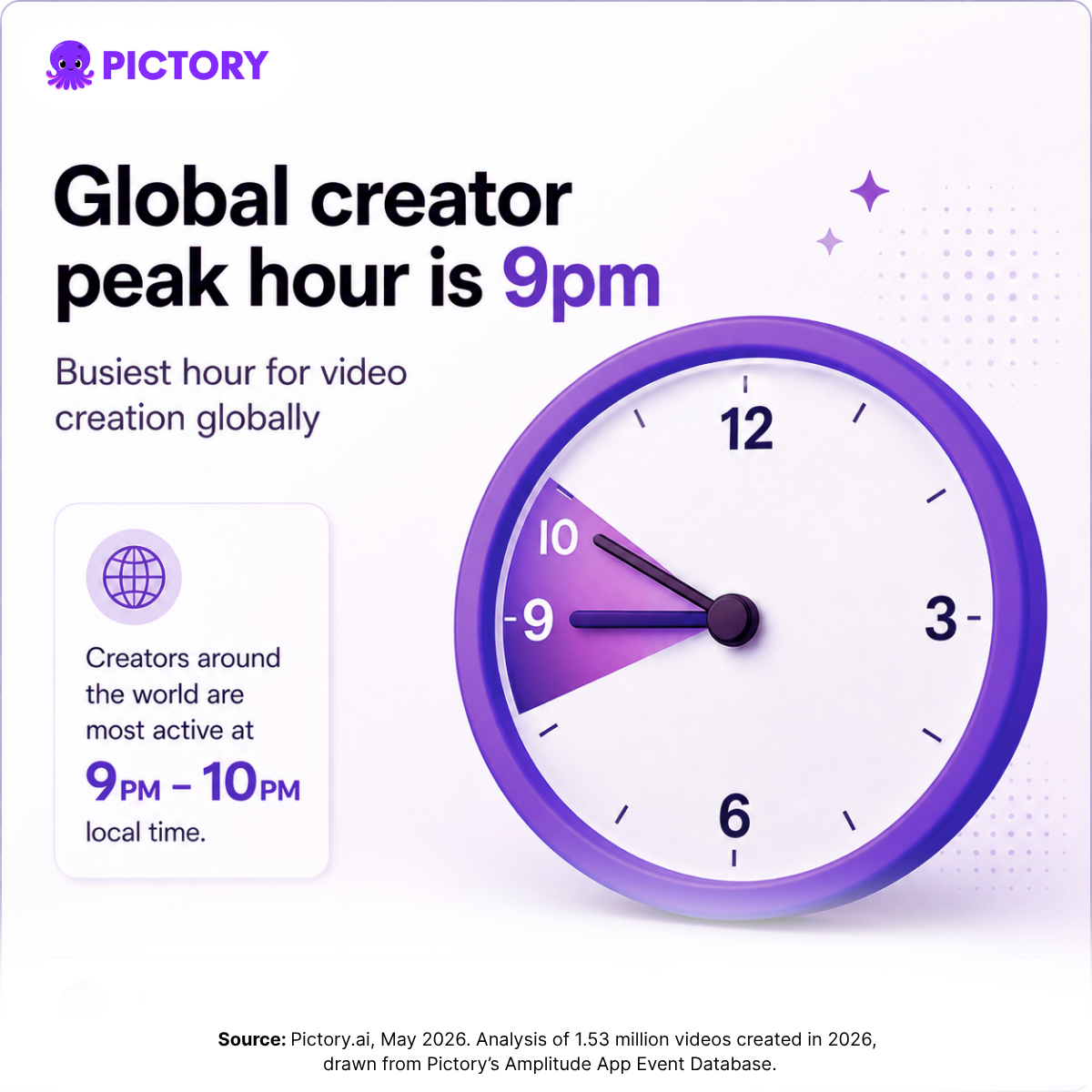
Insight: AI video tools are enabling a “creator economy after dark,” where content is produced outside standard working hours.
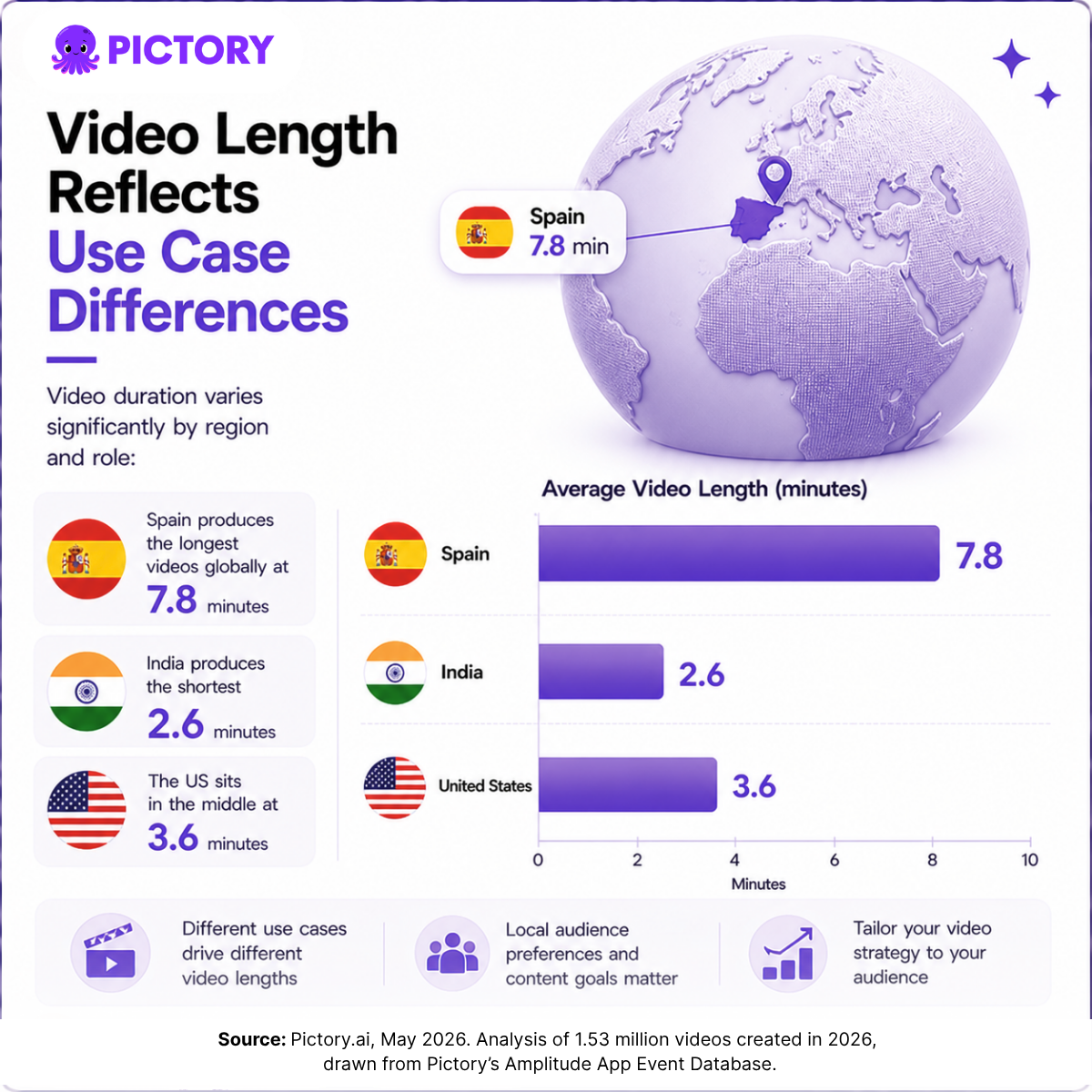
Video Length Reflects Use Case Differences
Video duration varies significantly by region and role:
Spain produces the longest videos globally at 7.8 minutes on average
India produces the shortest at 2.6 minutes; the US sits in the middle at 3.6 minutes
By role:
YouTube creators: 3.9 minutes (long-form engagement)
Employee communications: 3.5 minutes (training and internal content)
Training/Education: 2.7 minutes (modular learning)
Sales & Marketing: 1.7 minutes (short-form content)
Insight: AI video is not a single format. It adapts to distinct goals, from engagement to education to conversion.
Where a Creator Lives Dictates How They Create
Denmark Is the Voiceover Capital of the World
Danish creators upload custom voiceovers at 830 per 1,000 users, nearly 7x the US rate.
Insight: Smaller markets are often leading in high-effort, high-quality content production, emphasizing narration and localization.
The Philippines Leads in Music-Driven Content
Filipino creators add background music at 3.3x the rate of US creators.
Insight: Cultural preferences strongly influence how AI video is produced, especially in audio and storytelling styles.
Audio-to-Video Is Growing in Audio-First Markets
Vietnam leads globally in audio-to-video conversion (4x the US rate).
North Carolina leads within the US. Podcast culture and audio-first storytelling are deeply embedded in the Tar Heel State's creator community.
Insight: Podcasting and audio-first content ecosystems are driving demand for video repurposing.
AI Image Generation Is Expanding Rapidly
UK creators generate AI images at 2.3x the US rate
Indiana ranks second in the US, ahead of California
Insight: AI-generated visuals are becoming a core part of video workflows, not a niche feature.
Oregon Leads the US in AI Image Generation
Oregon creators generate AI images at 1,215 per 1,000 users, nearly 9x the US average.
Insight: AI-native creative behavior is highly concentrated in specific regions, often tied to tech-forward cultures.
AI Avatars Are Growing Unevenly Across Markets
UAE creators use avatars 77% more than US creators
UK and Australia lead English-speaking markets at 2.4x US rates
Pennsylvania creators select AI avatars at 638 per 1,000 users (4x higher than California and 6x higher than New York)
Insight: Avatar-led video is not evenly distributed. Certain regions are driving adoption of AI presenter formats.
Job Title Is a Key Indicator of Preferred Workflow
A professional’s role is now the primary determinant of video strategy and workflow selection. In 2026, content teams are moving away from generic tools in favor of role-specific workflows that optimize for speed, repurposing, and specialized output.
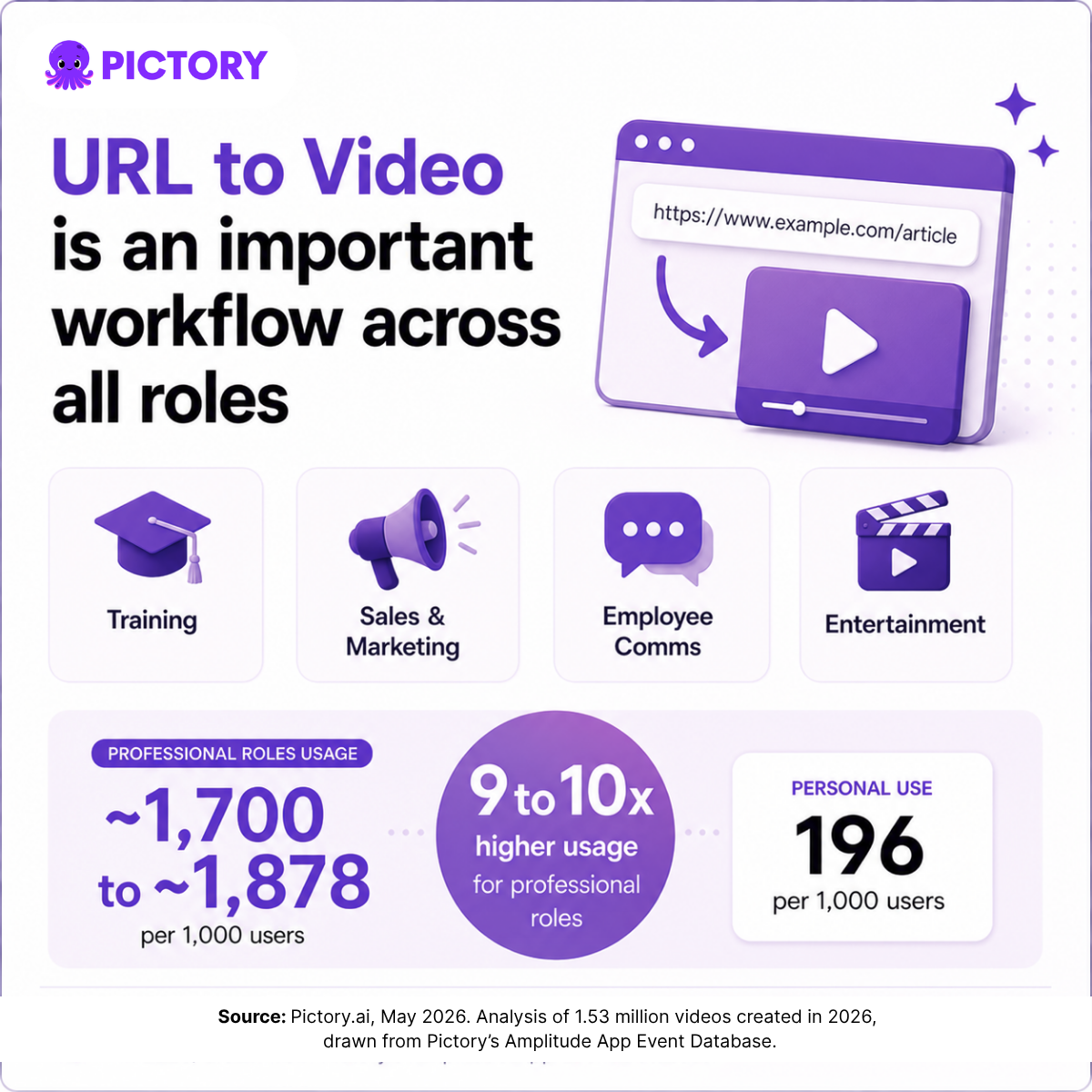
URL-to-Video Is a Core Professional Workflow
Professional users (Training, Marketing, Employee Comms, Entertainment) use URL-to-video workflows at 9x the rate of personal users.
Insight: AI video is increasingly used for content repurposing at scale, turning written content into video efficiently. This aligns directly with Pictory’s workflow, where users can input a URL, generate a script, and automatically create a storyboard and video.
PPT-to-Video Is Dominated by Education and Enterprise
Training/Education users are 4x more likely than YouTube creators to use PPT-to-video
Employee communications ranks second
Insight: AI video is becoming a core tool for internal training, onboarding, and knowledge sharing.
See these workflows in action
URL to Video, Audio to Video, PPT to Video, AI Avatars — every workflow in this report is available inside Pictory. Try the full platform free, no credit card required.
Get Started for FreeThe Platform Divide in Video-Creation: Mac Desktop Dominates
Voiceovers Signal High-Quality Content Production
Mac users upload voiceovers at 75% higher rates than Windows users
Seattle leads US cities in voiceover usage
Insight: Voiceovers correlate strongly with more polished, intentional video production.
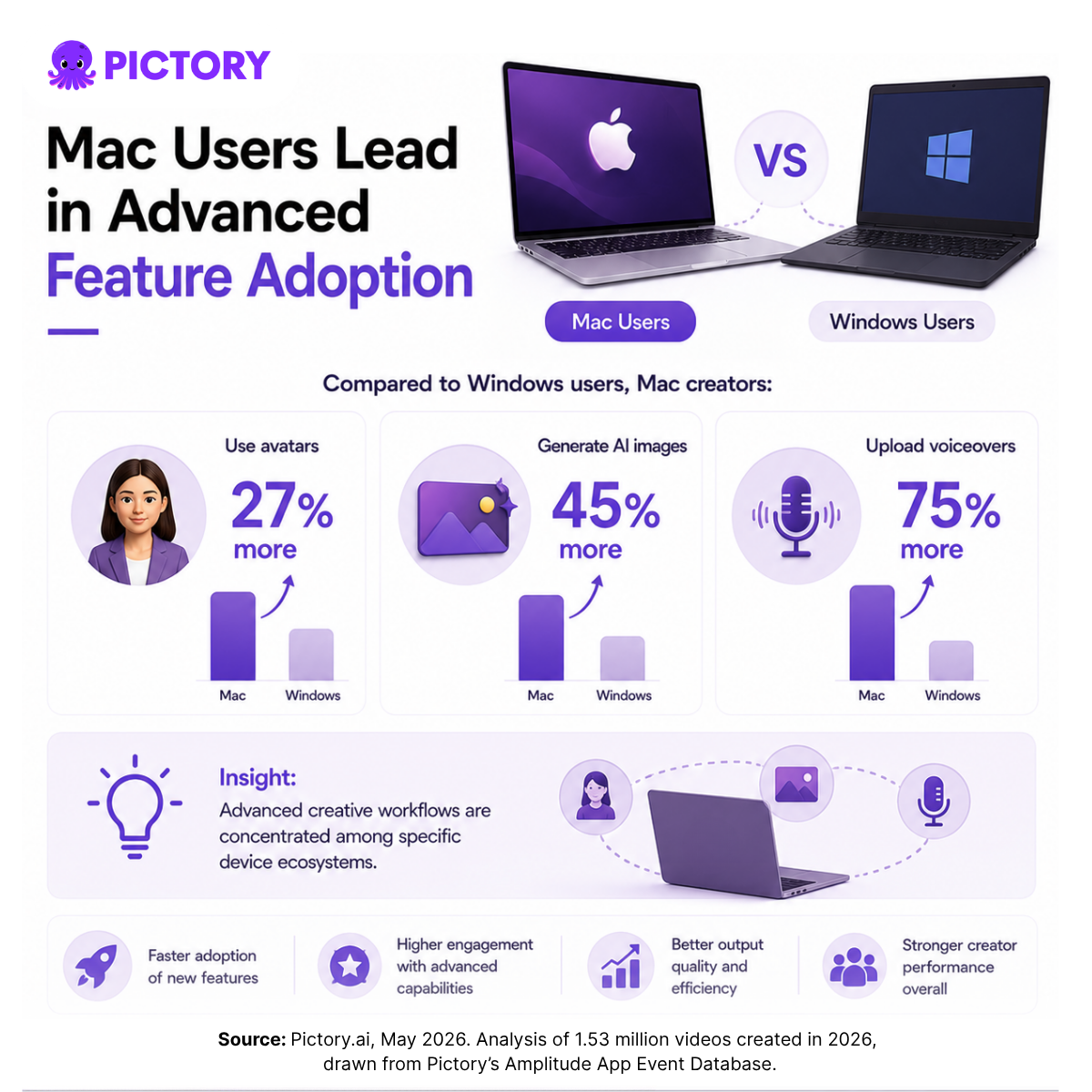
Mac Users Lead in Advanced Feature Adoption
Compared to Windows users, Mac creators:
Use avatars 27% more
Generate AI images 45% more
Upload voiceovers 75% more
Insight: Advanced creative workflows are concentrated among specific device ecosystems.
The Future and Takeaways
What This Means for the Future of Video Creation
The data points to several clear shifts:
AI video is becoming a primary content format across industries
Content creation is moving outside traditional working hours
Repurposing workflows (URL, audio, PPT) are scaling rapidly
AI-native formats (avatars, generated visuals) are gaining traction
Professional users are leading adoption, not hobbyists
Strategic Takeaways for Content Teams
To align with the 2026 professional standard, organizations should implement the following data-backed strategies:
External vs. Internal Videos: Optimize external marketing for rapid consumption (~90 seconds). Conversely, ensure internal communications (Employee Comms) allow for a longer 3.5-minute length for corporate clarity.
Integrate AI-Forward Features: Lean into AI-native features like avatars and Gen AI image generation. This is the new global benchmark for high-engagement, presenter-led video.
Reuse existing content: Maximize ROI in your business by reusing and repurposing your existing long-form content into market-ready videos.
Summary: The State of AI Video Creation 2026
The "Professional Standard" is now defined by the strategic use of AI-native features like avatars and generative imagery, localized duration strategies, and a shift toward repurposing-first workflows. Organizations that fail to adopt these data-driven norms will find themselves struggling to compete in an increasingly visual global economy.
FAQ: AI Video Creation Statistics 2026
How many videos did Pictory analyze for this report?
This report is based on aggregated, anonymized behavioral data from more than 1.5 million videos created on the Pictory platform in 2026. The analysis covers global users across multiple countries, workflows, feature usage patterns, creator segments, and device types. All metrics are normalized per 1,000 users to allow fair comparison across regions of different sizes.
What is the most popular AI video workflow in 2026?
URL-to-video is the dominant professional workflow, with professional users creating URL-to-video content at 9x the rate of personal users. This confirms that content repurposing — turning existing written content into video automatically — has become a core business workflow rather than a niche capability. PPT-to-video is the second most important workflow for enterprise and education users specifically.
Which country uses AI video creation the most?
The data shows that smaller markets are often leading in specific high-effort workflows rather than volume. Denmark leads the world in voiceover adoption at nearly 7x the US rate. The Philippines leads in music-driven content at 3.3x the US rate. Vietnam leads globally in audio-to-video conversion at 4x the US rate. The UAE uses AI avatars 77% more than US creators. Leadership in AI video is distributed across markets based on cultural and creative preferences rather than concentrated in one region.
What is the ideal length for an AI-generated marketing video?
The data is clear on this. Sales and marketing teams produce the shortest videos at an average of 1.7 minutes — optimized for rapid consumption and attention. YouTube creators average 3.9 minutes for engagement-driven content. Employee communications content averages 3.5 minutes. Training and education content averages 2.7 minutes, reflecting the microlearning preference for short, focused modules. The right length depends entirely on the use case and audience.
Are AI avatars becoming mainstream in video production?
Adoption is growing but unevenly distributed. UAE creators use avatars 77% more than US creators, and UK and Australia lead English-speaking markets at 2.4x the US rate. Within the US, Pennsylvania creators select AI avatars at 638 per 1,000 users — 4x higher than California and 6x higher than New York. The trend is clear: avatar-led video is gaining traction in specific markets and professional segments, with enterprise and education teams driving the most adoption.
![[Blog] - Training Video Cost & ROI: What It Actually Costs to Build a Program in 2026](https://pictory.ai/wp-content/uploads/2026/07/blog-training-video-cost-roi-2026-300x169.webp)