

![[Blog] - Training Video Cost & ROI: What It Actually Costs to Build a Program in 2026](https://pictory.ai/wp-content/uploads/2026/07/blog-training-video-cost-roi-2026.webp)
If you’re planning a program for 2026, training video cost is probably your first budget question, and the answer depends heavily on production style. Pictory changes the math for most of that range: a training video generator that turns a script or slide deck into a finished video cuts the scripting, voiceover, and re-shoot time that drives cost up in traditional production. This post breaks down real per-minute and per-program benchmarks and shows you how to measure whether your training video ROI holds up once learners start watching.
TL;DR
Training video cost in 2026 ranges from a few hundred dollars per finished minute for basic talking-head content to tens of thousands for interactive modules. Full programs run from $1,000 for a simple project to $150,000 or more for an enterprise, multi-module rollout. AI-assisted production is pulling per-minute costs down, and Pictory helps you plan a realistic budget, build training video content, and update it fast without hiring a full production crew.
What does a training video cost in 2026?
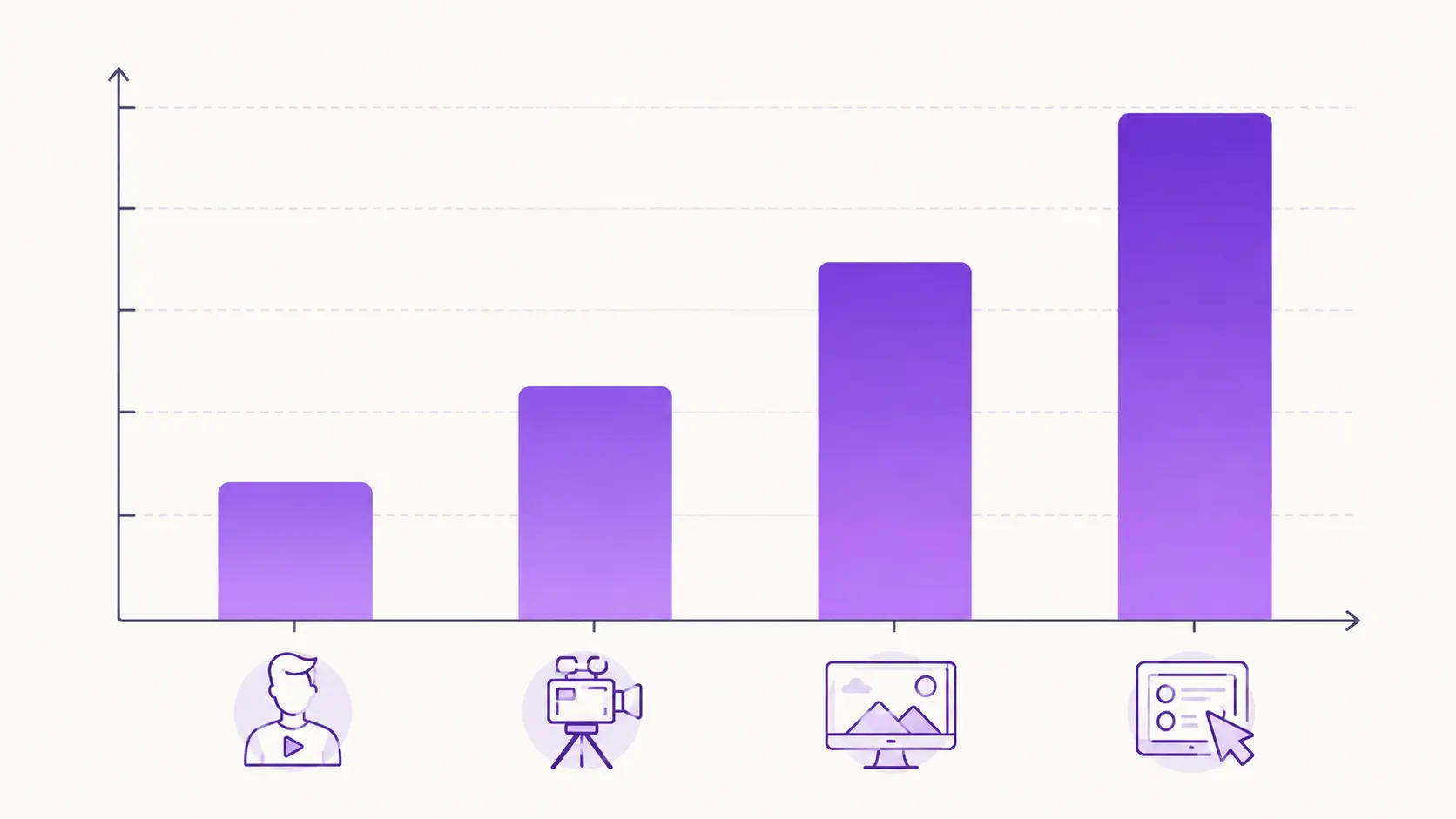
A finished minute of training video runs $500 to $1,500 for basic talking-head content, $1,500 to $5,000 for professional live-action, $2,000 to $8,000 for 2D animation, and $10,000 or more for interactive modules. Full programs follow the same spread: basic projects land around $1,000 to $5,000, while enterprise, multi-module rollouts can reach $25,000 to $150,000 or higher.
Those ranges scale with what the video needs to do. A short onboarding clip doesn’t need the same treatment as a certification course with branching decision points. Here’s how the per-minute cost breaks down by format.
| Video type | Cost per finished minute | Best for |
|---|---|---|
| Basic talking-head | $500 – $1,500 | Simple onboarding and internal announcements |
| Professional live-action | $1,500 – $5,000 | Customer-facing training and compliance videos |
| 2D animation | $2,000 – $8,000 | Software walkthroughs and abstract concepts |
| Interactive modules | $10,000+ | Certification programs and high-stakes compliance |
Source: Training video production cost breakdown, D-MAK Productions
What drives the cost of a training video?
Training video production cost rarely comes from the camera or the software. It comes from decisions made before anyone hits record. Five factors move the number the most.
Interactivity. A linear video you watch start to finish costs far less than a branching scenario with decision points, quizzes, and scored outcomes. Every branch is its own mini-video to plan, script, and edit.
Instructional design. Good training needs a learning objective, not just a script. Time spent mapping what learners need to know and testing whether the video actually teaches it adds cost up front, and saves rework later.
Format. Live-action shoots need a crew, a location, and talent. Animation needs illustration and motion design time instead. Either can cost more than the other, depending on the topic and how complex the visuals need to be.
Localization. Training built for one language rarely stays that way for long. Dubbing, subtitles, and culturally adjusted visuals each add a production pass, multiplied by every market you support.
Updates. Compliance rules change, software interfaces change, and org charts change. A video that needs a new segment every quarter costs more over its life than one you record once and never touch again.
These five factors compound. A localized, branching, live-action course that gets updated every quarter sits at the top of every range in the table above, while a plain talking-head video in one language, recorded once, sits at the bottom. When you get a quote that seems high or low compared to a benchmark, check these five factors first before you question the number itself.
How much does a finished hour of eLearning cost?
Developing one finished hour of eLearning costs $5,000 to $50,000 in 2026, and it typically takes 80 to 300 production hours for every finished hour, depending on how interactive the course is. For comparison, instructor-led delivery averages roughly $165 per learning hour, based on recent ATD-anchored benchmark data.
That production-hour ratio is the real cost driver behind any eLearning quote. A course built from simple video and text sits near the low end of the ratio. A course with simulations, branching logic, and custom graphics sits near the high end, because every added interaction needs its own design, build, and test cycle.
If a vendor quotes you a flat per-hour rate, ask which end of that ratio it assumes. A quote built on 80 hours of production per finished hour will look cheap next to one built on 300 hours, even if both vendors are pricing fairly for the interactivity level you actually asked for. Get the assumption in writing before you compare two bids.
How AI is changing training video cost
AI-assisted production is already moving the benchmark, and the savings come mostly from cutting the slowest parts of traditional production: scripting, voiceover recording, and re-shoots when something changes. A training video generator turns a script, a slide deck, or a document into a finished video without a camera crew or an edit bay.
Pair that with an AI avatar as your on-screen presenter and AI text to speech for narration, and you can update a training video the moment a policy changes, instead of re-booking a shoot. That’s the update problem from the section above, solved without adding a line item every time.
See your training video budget stretch further
Build, dub, and update training content without booking another shoot.
How do you measure training video ROI?
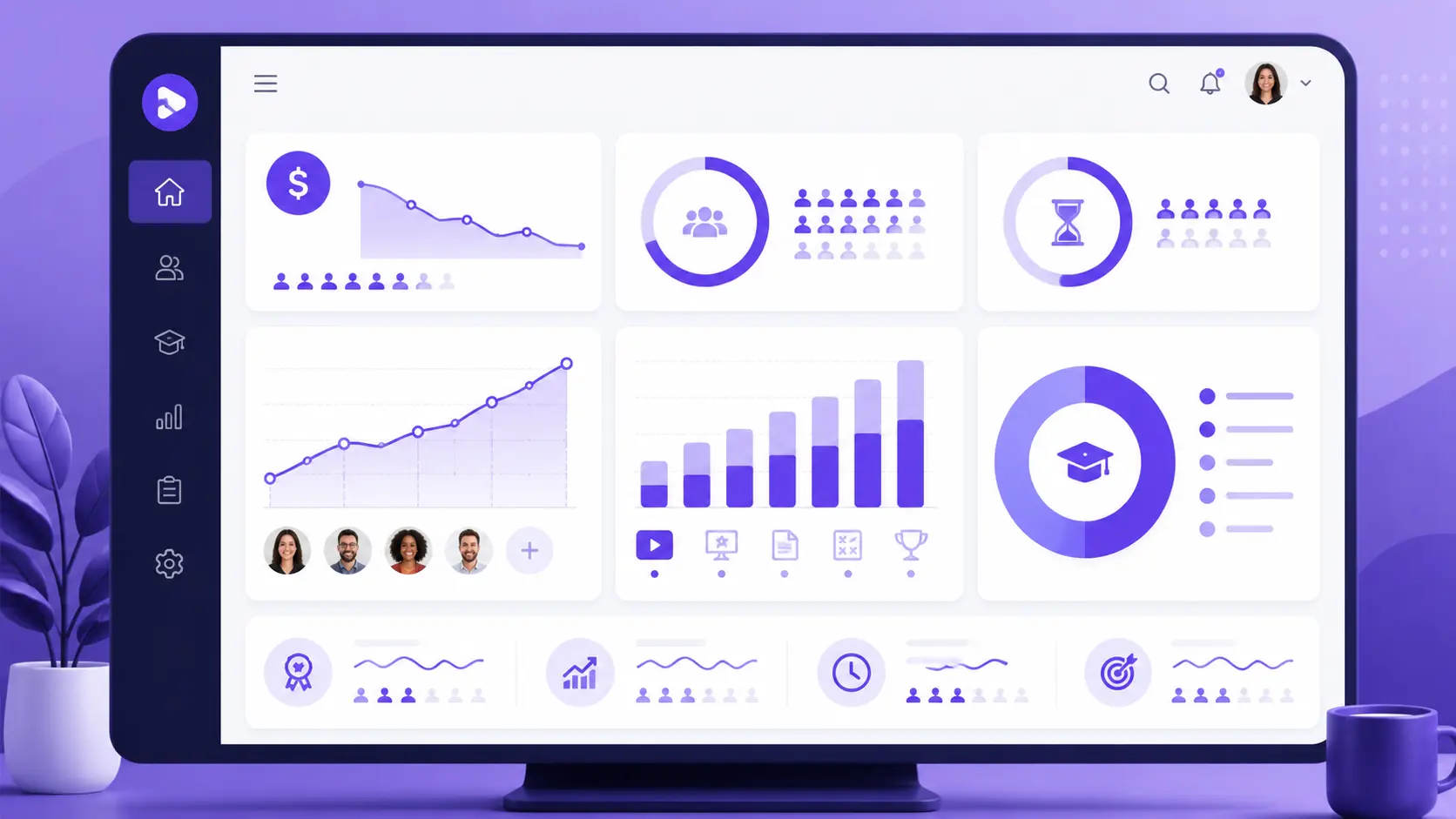
Training video ROI comes down to four numbers: cost per learner, completion rate, time-to-competency, and how much live training you replaced. Divide your total production cost by the number of learners who complete the course, then compare that against what instructor-led delivery would have cost at roughly $165 per learning hour.
Completion rate matters as much as cost. A video nobody finishes has no ROI, no matter how cheap it was to make. Track how many learners reach the end, how long it takes new hires to reach full competency compared to your old training method, and how many live sessions you no longer need to schedule. With 91% of businesses now using video as a marketing or training tool, the format itself isn’t the risk. The math only breaks down if your videos sit unwatched.
Set a baseline before you launch. Pull your current cost per learner from live sessions, note how long new hires take to reach full competency today, and record how many instructor hours a topic currently consumes. Once your training video is live, run the same three measurements again. The gap between the two sets of numbers is your ROI, not a guess.
How to lower your training video cost without cutting quality
You don’t have to choose between a bigger budget and a weaker program. A few levers bring the per-minute cost down while keeping the training useful.
Repurpose one video into several. A single training video can become a short refresher clip, a set of social posts for internal comms, or a quick-reference snippet. See how AI content repurposing stretches one production into multiple assets.
Swap re-shoots for edits. When a policy or product detail changes, editing a script and regenerating a voiceover costs far less than re-booking talent and a location.
Scale with the right plan. Pictory offers a free plan and paid tiers built for teams that need more volume, more seats, or tighter brand control. Check Pictory’s pricing to match a tier to your program size, or look at Pictory Enterprise if you’re rolling training out across multiple teams or regions.
If you want a walkthrough of the full process, the Pictory Academy guide to creating training videos covers it step by step.
Standardize your script template. Instructional design time drops when every course follows the same script structure: objective, key points, check for understanding, summary. You’re not cutting corners, you’re removing the guesswork that eats hours on every new project.
Batch your updates. Instead of editing one video every time something small changes, group minor updates into a scheduled quarterly pass. You’ll still catch errors fast when they matter, and you won’t pay for a dozen small edit cycles when one would do.
The verdict: what should you actually budget for?
If your training covers regulated, high-stakes, or safety-critical content, spend for it. Certification programs, compliance training with legal exposure, and courses with branching scenarios benefit from professional live-action or full instructional design support. The extra cost buys accuracy and a defensible audit trail, and that’s worth protecting.
Most L&D teams don’t need that tier for everyday programs. Onboarding, product updates, process walkthroughs, and internal announcements change often and don’t carry the same legal weight. These are exactly the videos that benefit from AI-assisted production: fast to build, fast to update, and produced in-house without a crew on standby.
Our recommendation: reserve premium production budget for the training that truly needs it, and move everything else to an AI-assisted workflow you control. Start with a small pilot program, measure completion and time-to-competency, and expand from there.
Ready to plan your 2026 training budget?
Build your first training video and see the real cost per minute for your team.
FAQ: Training Video Cost
What is the average cost of a training video?
It depends on format. Basic talking-head videos run $500 to $1,500 per finished minute, professional live-action runs $1,500 to $5,000, and interactive modules with branching or quizzes can cost $10,000 or more per minute, based on scope and instructional complexity.
How much does a full training program cost?
A basic training program with a handful of short videos typically costs $1,000 to $5,000, while an enterprise program with multiple modules, interactivity, and localization can reach $25,000 to $150,000 or more.
Does AI actually lower training video cost?
Generally, yes. AI-assisted production cuts the parts of traditional video production that take the most time and money: scripting, voiceover recording, and re-shoots whenever something changes. Because updates happen by editing a script and regenerating a voiceover instead of re-booking a crew, the cost of keeping a training video current drops sharply compared to traditional production.
How long does it take to build one hour of eLearning?
It generally takes 80 to 300 production hours for every finished hour of eLearning, depending on how much interactivity, branching, and custom design the course includes.
What is a good benchmark for training video ROI?
Compare your cost per learner against instructor-led delivery, which recent benchmark data puts at roughly $165 per learning hour. Then track completion rate and time-to-competency. A strong ROI shows lower cost per learner and faster competency than the live training it replaced.
Related Posts