

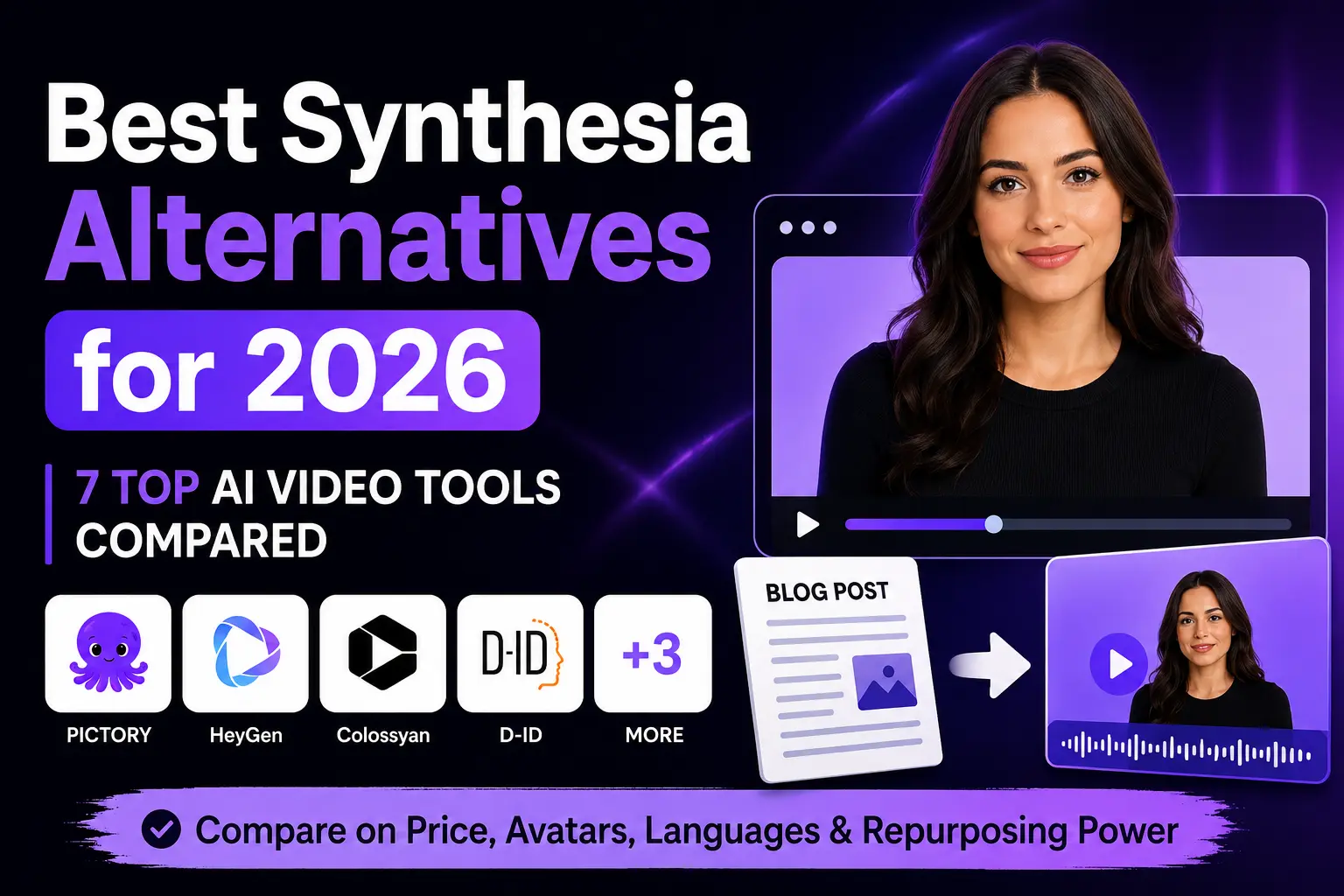
Synthesia turns a script into an avatar video, and it does that well. But if your job is turning blog posts, webinars, or long recordings into finished videos with voiceover and captions, an avatar generator only covers part of the job. That’s why so many marketers and educators search for synthesia alternatives. This guide compares seven tools, including Pictory, HeyGen, and Colossyan, so you can match the tool to your workflow, not just to an avatar.
TL;DR
Synthesia is strong at avatar-led training videos, but it’s not built to turn your blogs, scripts, or long recordings into finished marketing content. This guide compares seven synthesia alternatives, including Pictory, HeyGen, Colossyan, and D-ID, on price, avatars, languages, and repurposing power, so you can pick the tool that fits how your team actually works.

Why look for a Synthesia alternative?
Most teams look for a Synthesia alternative for three reasons: cost, workflow fit, and credit limits. Synthesia runs on monthly credits that don’t carry over, so a slow month still costs you the same. Its tools also center on avatar videos, not on turning blogs, decks, or recordings into finished video.
Synthesia’s paid plans are credit-based, and unused credits don’t roll over to the next month, so you can pay for capacity you never use. That works fine if your team publishes a steady stream of avatar training videos. It works less well if your content calendar is uneven, or if half your job is repurposing existing material, not scripting new avatar scenes from scratch.
The bigger limit is workflow. Synthesia starts from a script and an avatar. If you already have a blog post, a webinar recording, a slide deck, or a long-form video sitting in a drive somewhere, you still have to rewrite it as an avatar script before Synthesia can touch it. Teams that repurpose content for a living usually want a tool built around that starting point. We break down the full picture in our Pictory vs. Synthesia comparison.
What should you look for in a Synthesia alternative?
Before you compare synthesia competitors on price alone, get clear on how your team actually creates video. A tool that scores well on avatar realism but ignores your existing content library will still leave you rewriting everything by hand.
Input types
Can it start from a blog post, a URL, a script, a document, or a long recording, not just a typed script?
Repurposing power
Can it turn one long recording into short clips and captioned social videos on its own?
Avatars and voiceover
How realistic are the avatars, and can you add natural voiceover without recording anything yourself?
Languages
Does it support the languages your audience actually speaks, for captions and voiceover alike?
Price and billing model
Is pricing based on minutes, seats, or credits, and what happens to what you don’t use?
Governance
If you’re on an L&D or enterprise team, does it offer brand controls, roles, and approval workflows?
The 7 best Synthesia alternatives in 2026
Here are seven tools worth comparing to Synthesia, starting with the one built for content repurposing, then the strongest avatar-first and training-focused options.
1. Pictory: content repurposing at scale
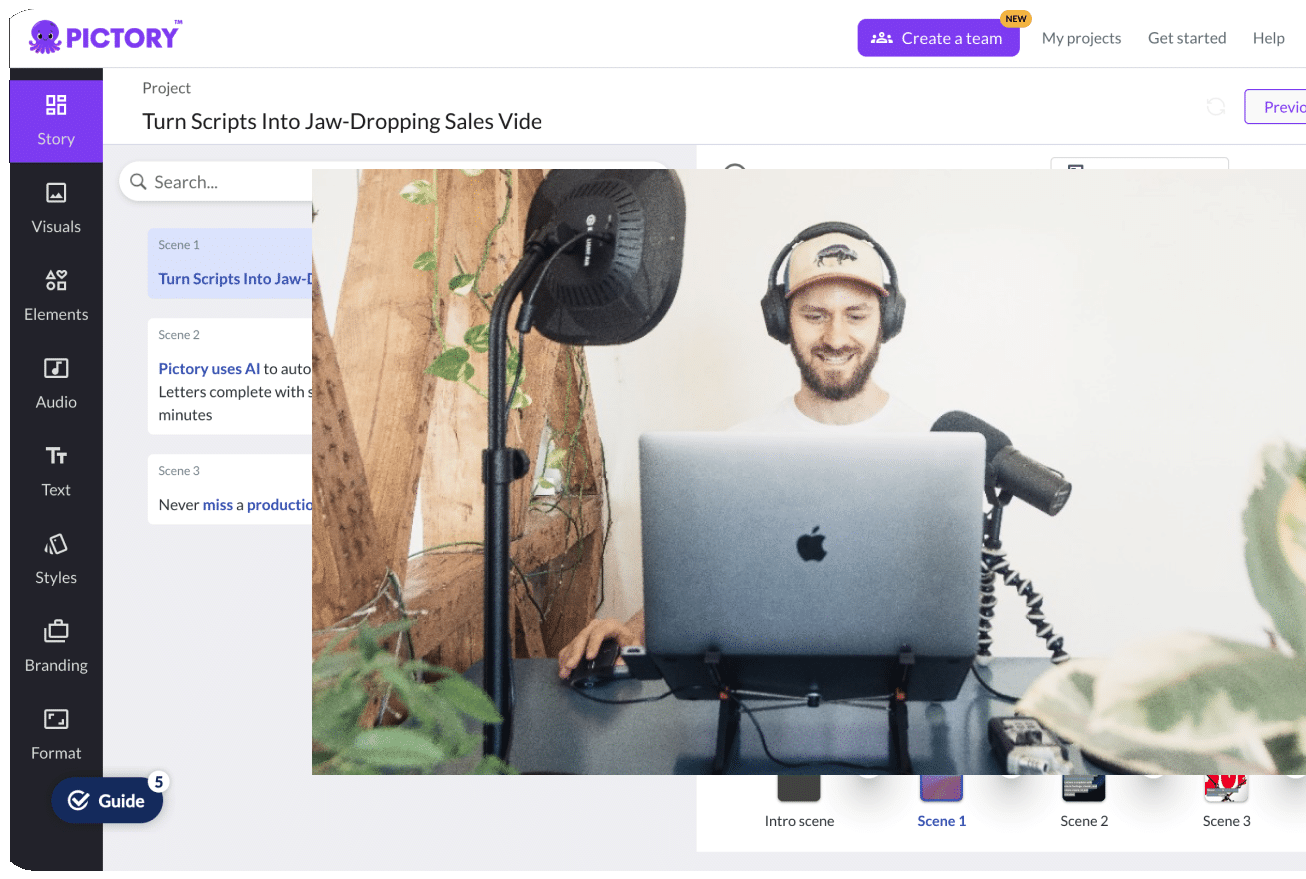
Pictory turns blogs, scripts, URLs, documents, and long recordings into finished videos with voiceover and captions. Instead of writing an avatar script from scratch, you paste in a link or upload a recording, and Pictory builds the video around it. It also includes AI avatars for teams that want a presenter on screen, so you get both repurposing and avatar video in one editor.
Best for: marketers and who publish blogs, webinars, or recordings and need them as video without starting over each time, and Learning and Development professionals who want to create learning content from existing materials like video, Powerpoint and other documents, and long form seminars.
Price: Pictory has a free plan and paid tiers built for content teams. See current pricing at pictory.ai/pricing.
2. HeyGen: avatar realism
HeyGen is an avatar-first video generator built around lifelike presenter movement. Its Avatar IV model is one of the more natural-looking options on the market today.
Best for: teams that need the most realistic avatar presenter and don’t need heavy content repurposing.
Price: entry plans start around $24 a month billed annually.
3. Colossyan: training and LMS
Colossyan is built for corporate training. It supports branching scenarios, quizzes, and SCORM export, so finished videos drop straight into a learning management system.
Best for: L&D teams that need compliance or onboarding training with quizzes and LMS support.
Price: plans start from $19 a month.
4. D-ID: budget avatar video
D-ID offers one of the lowest entry prices for simple avatar video, making it a fit for solo creators testing the format before committing to a bigger plan.
Best for: individuals or small teams who want basic avatar clips on a tight budget.
Price: plans start around $5.99 a month.
5. Veed: quick online editing
Veed is a browser-based editor built for fast subtitle and social clip edits, with avatar and AI tools layered on top of a traditional timeline editor.
Best for: teams that want a lightweight editor for quick social edits alongside occasional avatar clips.
Price: free tier available, with paid plans that scale by usage.
6. Runway: creative generative video
Runway focuses on generative video and visual effects rather than corporate avatar presenters. It suits creative experimentation more than repeatable marketing or training output.
Best for: creative teams exploring generative video and effects work.
Price: free tier available, with paid plans that scale by usage.
7. Canva: design-first video
Canva added a video tab and basic AI tools on top of its design suite. It’s convenient if your team already lives in Canva for graphics and wants a simple add-on.
Best for: teams already using Canva for social graphics who want a simple video option, not a dedicated repurposing engine.
Price: free tier available, with paid plans that scale by usage.
Which Synthesia alternative is right for you?
Pick based on your workflow, not just the avatar. Choose Pictory if you repurpose blogs, webinars, or recordings into marketing video or training content. Choose HeyGen for the most realistic avatar presenter. Choose Colossyan for LMS-ready training content. Choose D-ID if you need the lowest entry price for basic avatar clips.
How do the prices compare?
Pricing models differ almost as much as the tools themselves. Synthesia’s free plan gives you 10 minutes a month with a watermark, and its paid plans move to a credit system where Starter runs $29 a month, or about $18 a month billed annually, and Creator runs $89 a month, or about $64 a month billed annually. Enterprise pricing is custom. Here’s how the seven alternatives stack up.
| Tool | Best for | Starting price |
|---|---|---|
| Pictory | Content repurposing, marketing video and training / educational content | Free plan, paid tiers at pictory.ai/pricing |
| Synthesia | Avatar-led training video | Free (10 min/mo), $29/mo Starter |
| HeyGen | Avatar realism | From $24/mo (annual) |
| Colossyan | Training and LMS | From $19/mo |
| D-ID | Budget avatar video | From $5.99/mo |
| Veed | Quick online editing | Free tier, paid plans vary |
| Runway | Generative video and effects | Free tier, paid plans vary |
| Canva | Design-first video add-on | Free tier, paid plans vary |
Where Pictory beats Synthesia for content teams
Synthesia has a real edge in enterprise avatar realism and language reach, with more than 125 avatars and support for over 140 languages. For pure avatar presenter work at that scale, it’s a genuinely strong option. But most content teams aren’t only making avatar videos, they’re turning existing work into video, and that’s where the gap shows up.
This matters because content teams don’t just need one video, they need a webinar turned into ten clips, a blog turned into an explainer, and a script turned into a captioned post, often in the same week. Pictory covers all three from one library of tools. Synthesia covers the last one well, and asks you to rebuild the rest as a script.
Cost adds up the same way. Synthesia’s credit model charges for capacity whether you use it or not, while Pictory’s free plan and paid tiers are built for teams publishing content regularly, not for occasional avatar scenes. And the payoff for showing up with video at all is real: 82% of marketers say video gives them good return on investment, which makes the cost of your tool matter as much as its output.
Turn your content into video today
Bring a blog, a script, or a recording, and see it become a finished video with voiceover and captions.
The verdict
Pictory is the right fit for a solo marketer publishing blogs and social clips without a video editor on staff, or an educator who needs training or lecture content turned into video at a low cost. If your week involves taking something you’ve already written or recorded and getting it in front of an audience as video, Pictory’s repurposing tools do most of the heavy lifting for you.
Synthesia and other avatar-first tools still make sense for large enterprise L&D teams that need strict governance, approval workflows, and the widest possible avatar and language library for scripted training at scale. If your content mostly starts as a script and never touches an existing blog, deck, or recording, an avatar-first tool may serve you better than a repurposing tool.
For most marketing and education teams, though, content already exists before the video does. Pictory starts there.
See how quickly your next post becomes a video
No credit card required to start.
FAQ: Synthesia Alternatives
What is the best Synthesia alternative for marketers?
Pictory is the strongest option for marketers because it turns blogs, scripts, and recordings you already have into finished video with voiceover and captions. Synthesia works from a script alone, so marketers who repurpose existing content usually get more done with a tool built around that starting point.
Is there a cheaper alternative to Synthesia?
Yes. D-ID starts around $5.99 a month, and Colossyan starts around $19 a month, both below Synthesia’s Starter plan. Pictory also offers a free plan and paid tiers built for regular content publishing, so cost scales with your workflow instead of unused monthly credits.
Can I make a video from a blog post or URL instead of writing a script?
Yes, with Pictory. You can paste in a URL or blog post and Pictory builds a video around it automatically, including voiceover and captions. Synthesia and most avatar-first tools require you to write or paste a script before they can generate anything.
Does Synthesia offer more avatars and languages than its alternatives?
Synthesia offers a wide library, with over 125 avatars and support for more than 140 languages, which is strong for enterprise training. Alternatives like Pictory and HeyGen also offer avatars and multiple languages, though teams choosing Synthesia are usually prioritizing avatar breadth over content repurposing.
Which Synthesia alternative works best for training and LMS content?
Colossyan is built specifically for training, with branching scenarios, quizzes, and SCORM export for direct LMS upload. If your training content also needs to be repurposed from existing decks or recordings, Pictory covers that step before the video ever reaches your LMS.
Related Posts