

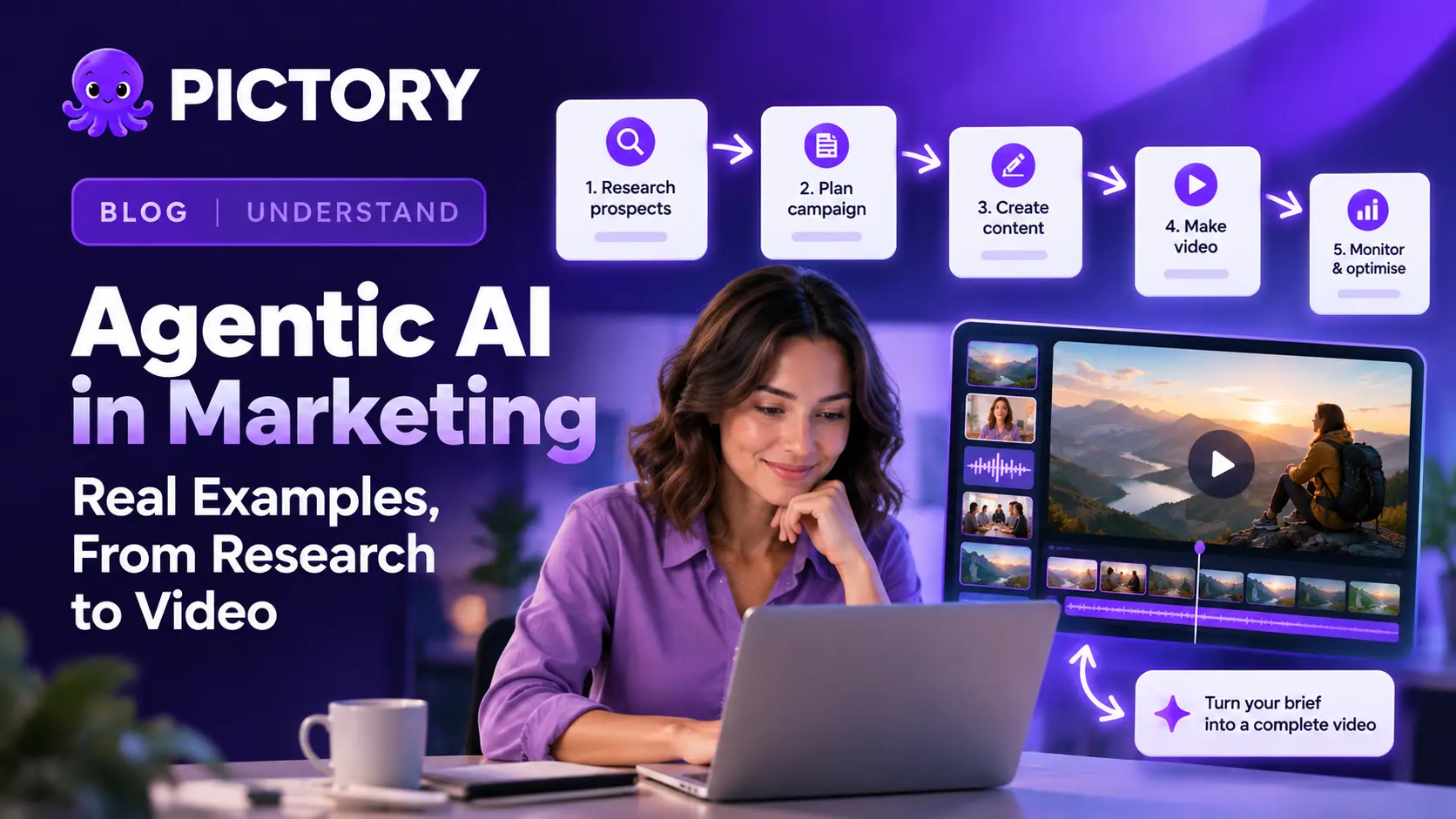
Agentic AI examples are common in IT and customer service. Marketing and video are harder to picture. This post collects real examples of agentic AI in marketing teams, then shows what the same idea looks like when the job is making a video. The video example is Pictory 3, which uses an AI video agent to turn your brief into a script, scenes, and a preview you approve.
TL;DR
Agentic AI is AI that works toward a goal with limited supervision, planning and carrying out several steps. In marketing, agents already research prospects, draft content, plan campaigns, and monitor channels. In video, an agent can plan the story, write the script, pick visuals, and build a preview. Good setups keep a human approving the important steps.
What is agentic AI?
Agentic AI is AI that works toward a goal with limited supervision. Instead of answering one prompt, an agent plans the steps, uses tools, and carries them out. People set the goals and rules, and stay involved for approvals.
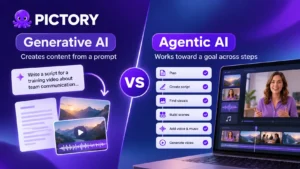
IBM defines agentic AI as a system that can accomplish a specific goal with limited supervision, and describes an AI agent as a system that autonomously performs tasks by designing workflows with available tools. For the video version of that idea, read What is an AI video agent?. To see how agents differ from prompt-based tools, read generative AI vs agentic AI for video creators.
What are examples of agentic AI in marketing?
Marketing agents handle research, content, campaign planning, and monitoring. Examples include agents that research prospects, draft blog and social posts, build campaign briefs and audience segments, plan content, and flag negative sentiment across channels.
Prospect and customer research
HubSpot announced a Data Agent that researches customers or prospects by scanning a company’s customer data and the web, and a Prospecting Agent that monitors prospects for buying signals, as reported by TechTarget.
Drafting content
HubSpot said its pretrained marketing agents would create landing pages for account-based outreach, search video clips, and draft blog and social posts, according to TechTarget. A Jasper agent takes a brief, plans content, researches topics, and generates blogs, posts, and ads, per a Cloud Campaign roundup.
Campaign planning
Salesforce’s Agentforce agents build campaign briefs, personalize customer engagement, and generate audience segments, according to the same roundup.
Channel monitoring
Sprinklr’s agents monitor more than 30 channels, flag early negative sentiment, and enforce approvals and kill switches, per the roundup.
What are examples of agentic AI in video?
Agentic video is early. Marketing platforms are adding agents that search video clips, and design tools take natural-language edits. An AI video agent goes further: it takes a brief and plans the story, writes the script, proposes visuals, and builds a preview.
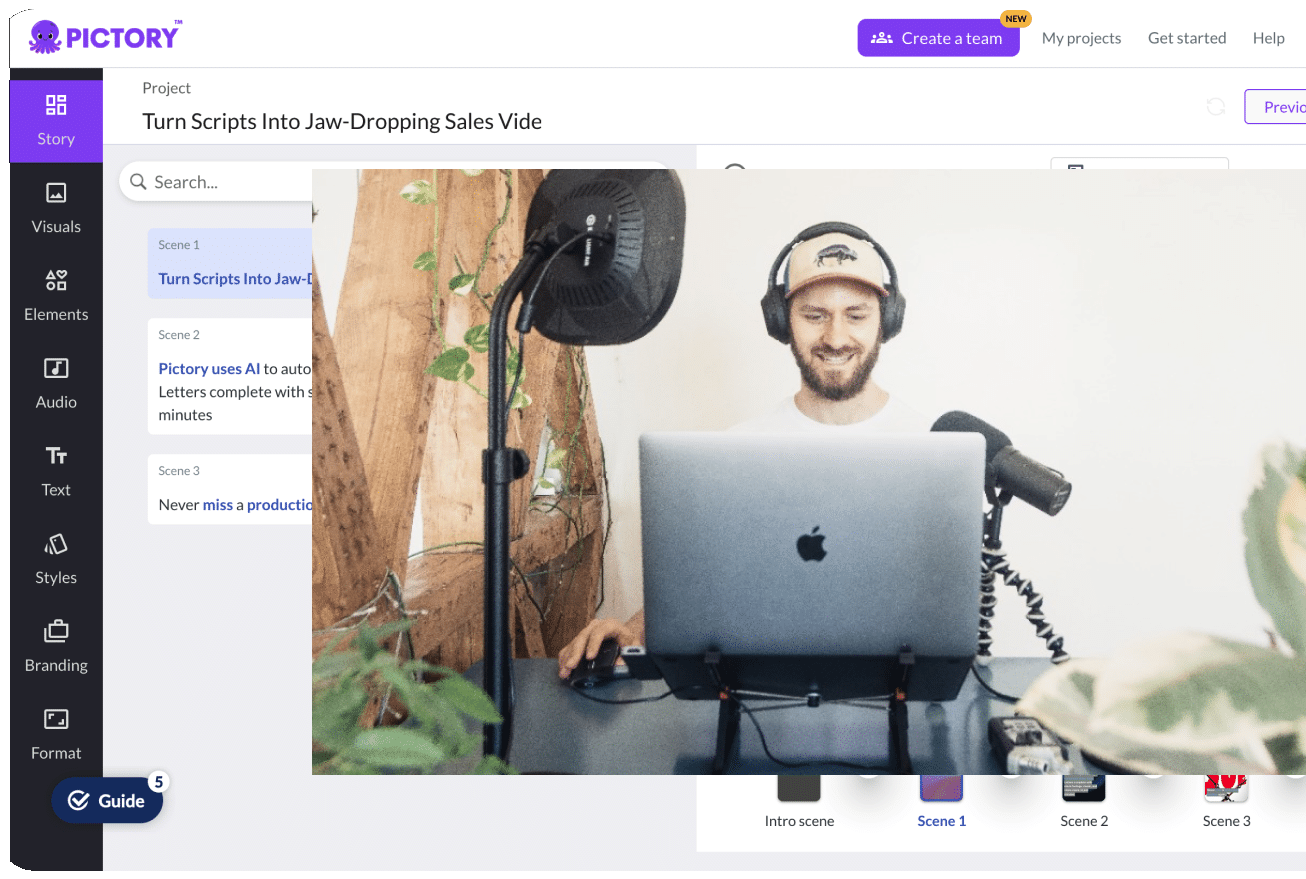
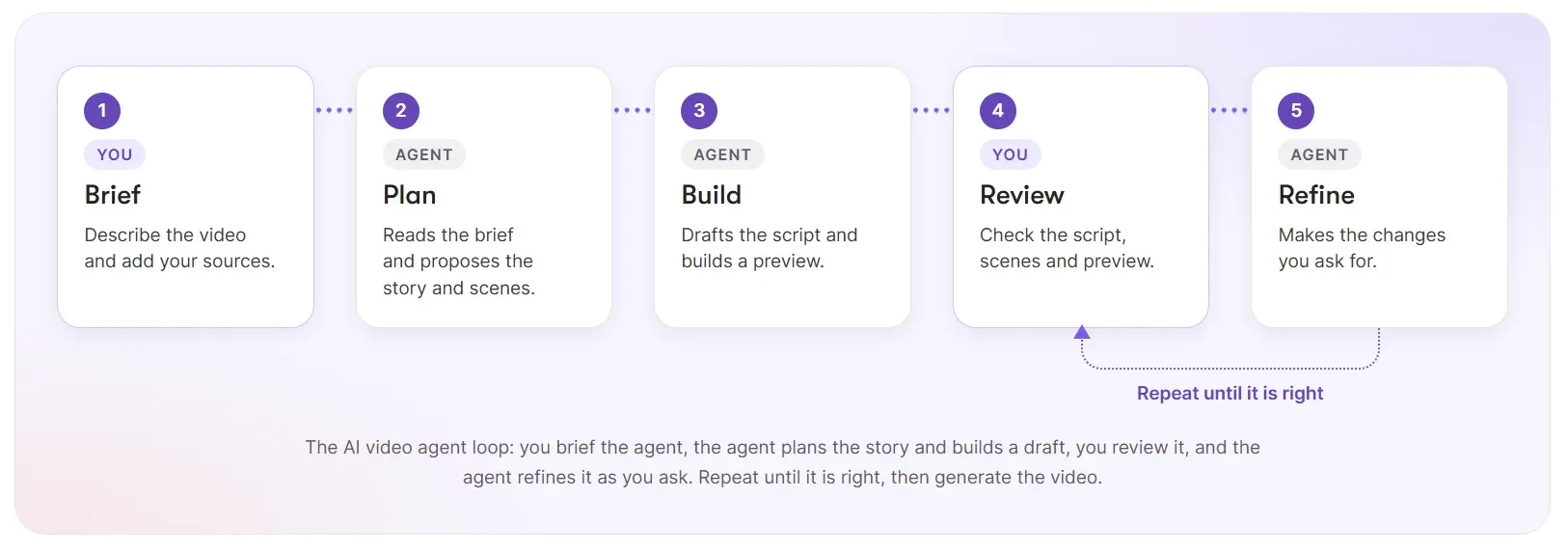
Our example is Pictory 3’s AI video agent. You describe the topic, audience, purpose, and length, and add any source files or URLs. The agent asks five setup questions, prepares a script and scenes, and creates a preview. You review the story, refine it by chat or in the editor, and generate the final video. The agentic AI video workflow page walks through all seven steps.
Other tools sit at different points on the spectrum. The roundup describes Adobe’s AI Assistant in Express as editing designs from natural-language requests, and notes it is not a fully autonomous agent that can schedule, distribute, or track campaign performance.
What do these agentic AI examples have in common?
Each one starts from a goal, not a single prompt. Each runs several steps, such as researching, drafting, and checking. And each leaves a place for a person: a brief at the start, an approval in the middle, or a review at the end.
That pattern holds for video. The brief names the audience and purpose. The agent drafts the story. You approve the script before the preview and the preview before you generate.
Where should a human stay in the loop with AI agents?
Keep a person in the loop wherever a mistake is costly or public. IBM recommends that agents require human approval before highly impactful actions, such as mass emails or financial trades. For video, that means approving the script and checking facts before the final file.
IBM describes this under human oversight for AI agents: agents need human-defined goals and rules, and users should be able to interrupt them. In a video workflow, that translates into three checks: compare facts, names, dates, and numbers with your source; read the narration aloud; and play the downloaded file before you publish. For what the agent handles and what stays with you, see AI video automation in Pictory 3.
How can you try an agentic workflow for video?
- Pick one source you already trust. A document, a help article, or a short brief works well.
- Write a specific brief. Name the audience, purpose, length, tone, and ending.
- Review before you generate. Check the script and scenes, then play the preview from start to finish.
The Academy guide How to create a video with Pictory 3 shows each screen. For the overview, see What’s new in Pictory 3.
Try an AI video agent on your content
Describe it, review the story, and generate when you’re ready.
Is agentic AI worth trying for your marketing?
Agentic AI is worth trying if your team spends more time assembling work than deciding what it should say. Research, first drafts, and repeatable production steps are where agents help most today.
It’s a weaker fit where the process isn’t defined yet, or where one error is expensive and nobody reviews the output. The roundup notes that some tools require a highly structured process definition upfront and that autonomous replies need careful guardrails. Treat each agent as a fast colleague whose work you check.
Our recommendation: start with one low-risk, repeatable job, keep a person approving the result, and measure the time you save on assembly. If that job is turning documents or ideas into video, try it in Pictory 3, starting with the guide to turning a document into a video.
Brief it. Review it. Generate it.
Put an AI video agent to work on your next video.
FAQ: Agentic AI in Marketing
What is an example of agentic AI in marketing?
Examples include agents that research prospects, draft blog and social posts, build campaign briefs and audience segments, plan content, and monitor channels for negative sentiment. Roundups describe HubSpot, Salesforce, Jasper, and Sprinklr as offering agents of this kind, and in each case a person still sets the goal and reviews the output.
What is an example of agentic AI in video?
An AI video agent takes a brief and handles the production steps: planning the story, writing the script, proposing visuals, and building a preview. In Pictory 3, you review the story, refine it by chat or in the editor, and generate the final video when you’re ready.
Is agentic AI the same as automation?
Not quite. Traditional automation follows fixed rules you set up in advance. Agentic AI works toward a goal and decides which steps to take along the way, using tools as needed. Even so, people define the goals and rules and approve high-impact actions.
Do AI agents work without human oversight?
They can work with limited supervision, but good practice keeps people involved. IBM recommends human approval before highly impactful actions and the ability to interrupt an agent. For video, review the script, check facts against your source, and play the final file before sharing.
How do I start using an AI video agent?
Pick one source you trust, such as a document or a short brief, and write down the audience, purpose, length, and tone. Add it in Pictory 3, answer the setup questions, review the script and scenes, then refine and generate. The Academy guide walks through each step.
Keep exploring
The hub: everything in Pictory 3 and where to start.
The definition, and how an agent compares with a generator and an editor.
The seven steps from brief to download.
Academy guide, screen by screen.