

TL;DR
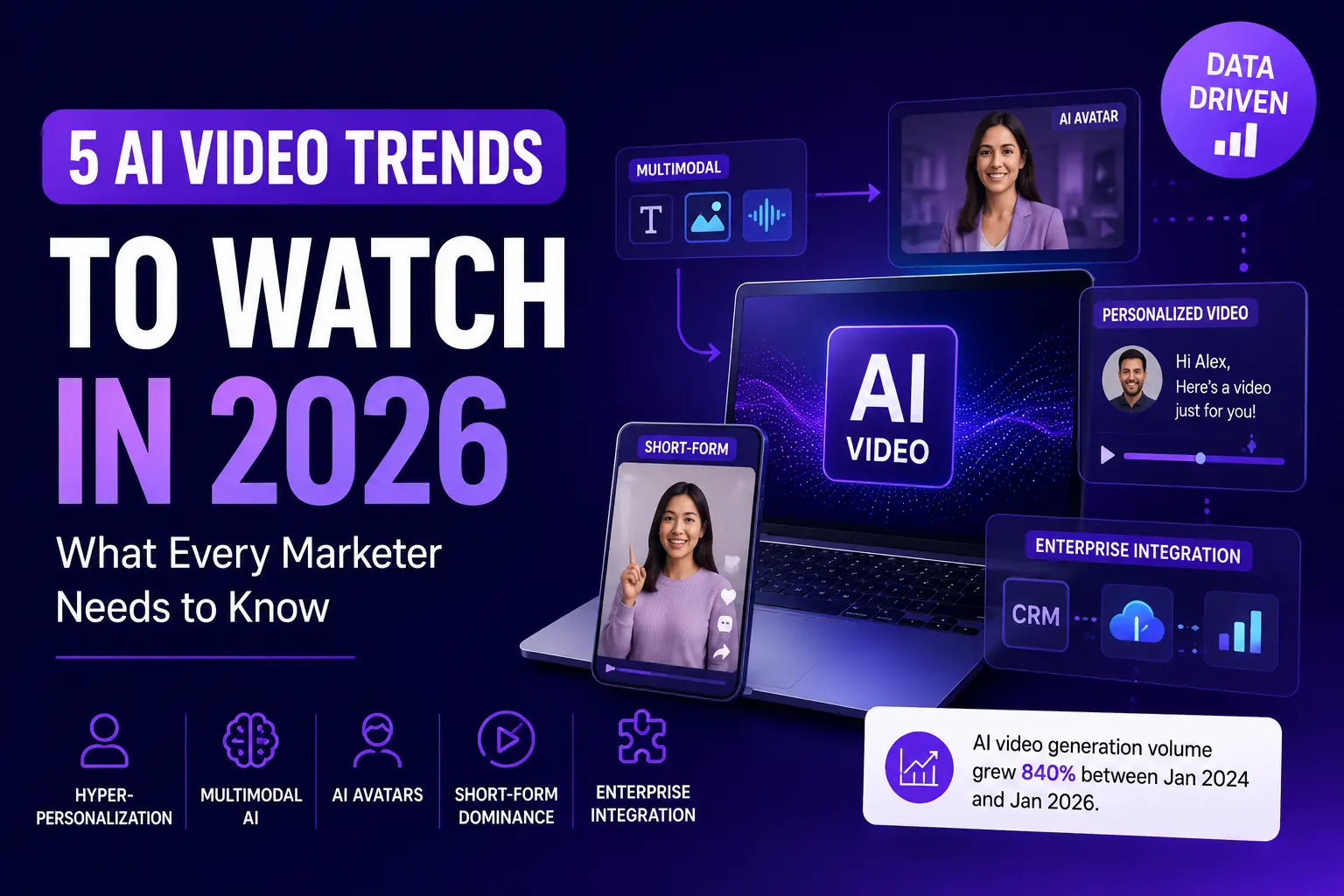
AI video is moving from experiment to operating standard. In 2026, five shifts are changing how marketing teams produce content: hyper-personalization, multimodal generation, AI avatars, short-form dominance, and deeper enterprise integration. The teams winning aren’t producing more from larger budgets, they’re producing more from smarter workflows. This article breaks down each trend, the data behind it, and what to do next.
Eighty-seven percent of creative professionals now use AI tools for video creation, and two-thirds use them weekly. Most marketing teams have adopted AI video already. The question now is which trends to plan around. Pictory will help you cut through the noise and picked the five AI video trends that will shape content output, budgets, and team workflows through 2026. The latest video marketing data backs up every shift below.

What are the biggest AI video trends in 2026?
Five trends define AI video in 2026: hyper-personalization at scale, multimodal AI workflows that handle text, image, and voice in one pipeline, rising avatar adoption, short-form dominance across every platform, and tighter integration with enterprise content stacks. Teams putting these to work are producing up to 11 times more video per month without expanding headcount.
These shifts share a common thread. They reduce the manual production work that used to define video creation. The bottleneck is no longer “can we make the video?” Now it’s “what do we make next?” That changes how you plan content, structure your team, and measure output.
The rest of this article unpacks each trend with data from the platforms and reports tracking adoption.
Why short-form video isn’t slowing down
Short-form is still the format winning attention, and AI is making it harder to ignore.
YouTube Shorts now generates over 70 billion daily views. TikTok users in the US spend over 24 hours per month inside the app. Instagram Reels accounts for 41% of all time spent on Instagram. Those aren’t the same audience watching the same content three times. They’re three separate creative contexts with different expectations.
For a long time, this was a production problem. Producing platform-native variants meant tripling editing time, and most lean marketing teams couldn’t keep up. AI tools have changed that. A single script can now generate multiple aspect ratios, language versions, and pacing variants in minutes, not days. Teams that ship consistently across formats outperform teams that publish occasionally to one channel.
AI video generation volume grew 840% between January 2024 and January 2026. Vivideo platform data
What this means in practice: short-form output is moving from “we’ll post when we have something” to “we’ll post on a schedule because production isn’t the constraint anymore.”

How are AI avatars and voiceovers changing video production?
AI avatars and AI voices have moved from gimmick to standard production tool in 2026. Fifty-eight percent of AI marketing videos now use AI voiceovers in place of human recordings, and 36% of brands have started using AI avatars to present scripts on camera. These features let teams produce on-camera content without scheduling shoots, hiring talent, or re-recording when scripts change.
The use cases that work best follow a pattern. Internal training videos, product walk-throughs, multilingual announcements, and recurring content series all benefit from the consistency AI delivers. The shift matters most for teams that need to publish frequently and need every video to look the same. The bigger picture in how enterprise teams are using AI video shows the same pattern at scale. Pictory’s AI avatar generator fits this workflow, pairing avatars with voiceovers inside a single production pipeline.
There’s still a tradeoff. AI avatars work well for informational content, but they aren’t a substitute for brand-defining hero videos where authentic human delivery is part of the message. Most teams use a mix: AI for volume, human for high-stakes.
What does AI-generated video personalization actually look like?
AI video personalization in 2026 means producing variants of the same core video for different audience segments, regions, or funnel stages, without manually editing each one. Dynamic AI-personalized video ads are seeing click-through rates of 6 to 7%, well above the 2% benchmark for standard video ads.
In practice, that looks like a B2B team generating 12 versions of a product demo, each one tuned to a specific industry. Or a marketer producing localized variants of a launch video for 20 markets, with translated voiceovers and captions, in an afternoon. None of that was realistic three years ago for teams without enterprise budgets.
The technology that makes this work, text-to-video pipelines with brand kits, multilingual voiceover libraries, and reusable templates, is now standard in mid-market platforms. Personalization is possible. The real question: does your content calendar take advantage of it?
Which workflows are teams automating with AI video tools?
The biggest production savings in 2026 come from automating the workflow steps that used to take the longest.
AI editing tools now reduce production time by 50 to 80% across the board. The work getting automated includes script drafting, scene selection, B-roll sourcing, caption generation, voiceover production, and aspect-ratio conversion for different platforms. Each of these used to require a specific skill or a separate tool. In 2026, they happen inside a single AI workflow.
A typical example: a marketer starts with a blog post, generates a script, chooses a brand-aligned template, generates voiceover, and exports a 60-second social video, all in one platform, in under an hour. The same project would have required a freelancer, a few rounds of revisions, and at least a week of calendar time.
Paste a script, generate a storyboard in minutes
Turn a blog post or article into a branded video
Convert podcasts or recordings into shareable clips
Transform slide decks into narrated video content

What AI video trends should marketers prepare for next?
Looking past 2026, three trends are worth watching. Interactive video, AR/VR overlays, and autonomous content pipelines that produce, distribute, and measure content with minimal human input. By 2028, AI-generated video is projected to account for 35% of all social media video, and by 2030, 90% of online video is expected to involve some form of AI assistance.
You don’t need to adopt every emerging technology right now. But the teams building a clean, repeatable AI video workflow today will be in a much stronger position when these capabilities arrive. Production volume becomes table stakes. The teams that win on creative judgment, distribution strategy, and brand voice are the ones that have removed production friction first.
If you’re starting now, the goal is to build a process that scales, then adapt as new capabilities go live. The teams that waited through 2024 and 2025 are now playing catch-up. The cost of inaction compounds.
Turn your next idea into a video in minutes
No editing skills needed. Start with a script, URL, or slide deck.
The verdict: where AI video fits in your 2026 plan
If you’re running content for a small or mid-sized team and feeling the pressure to ship more video without growing the team, AI video tools are the right fit for your 2026 plan. The economics now favor adoption. Production costs have dropped roughly 97% since 2020, and a video that took 13 days to produce a few years ago now renders in around 27 minutes. For a lean marketing team juggling content, social, and email, AI video is the difference between “we ship video occasionally” and “video is a steady channel.”
That said, AI video isn’t a substitute for creative judgment. The data is clear: more teams producing video means more teams producing forgettable video. The differentiator in 2026 is point of view, not production volume. If your brand voice is muddy or your strategy is reactive, AI will help you publish forgettable content faster. That’s worth taking seriously before scaling output.
The right next step is to pick one workflow and run it for 30 days. Turn a blog post into video, repurpose a webinar recording, or build a short-form social series from an existing script. See what AI does well, where it falls short, and what it changes about your output.
FAQ: AI Video Trends 2026
What is the fastest-growing AI video trend in 2026?
Short-form, AI-generated content is the fastest-growing trend by volume. YouTube Shorts passes 70 billion daily views, and teams are using AI to produce platform-native variants of the same script in minutes rather than days. The ability to ship consistently across formats, not occasionally to one channel, is the real competitive edge.
Are AI video tools replacing human video editors?
Not yet, and not completely. In 2026, AI handles the time-consuming production steps: scripting drafts, B-roll selection, captions, and format conversions. Human editors focus on creative direction, quality control, and brand judgment. Teams that combine both approaches report producing up to 11 times more video per month without growing headcount.
How much does AI video production cost compared to traditional production?
Production costs have dropped roughly 97% since 2020. What once cost $1,500 per freelance project now renders for under $15 with AI tools. A 60-second marketing video that took 13 days to produce now takes around 27 minutes with a platform like Pictory, while still hitting the quality bar most teams need.
What AI video trend matters most for B2B marketers?
Personalized video at scale. B2B teams are using AI to create tailored product demos, prospect videos, and onboarding sequences without multiplying production time. LinkedIn native video achieves engagement rates of 5.1 to 6%, far above static content, and AI makes maintaining that consistent volume realistic for lean marketing teams.
Will AI video tools be mandatory for content teams by 2027?
The data points that way. By 2028, AI-generated video is projected to account for 35% of all social media video, and by 2030, 90% of online video is expected to involve some form of AI assistance. Teams that delay adoption face a growing production gap. Competitors using AI are already shipping more content faster and at lower cost.
![[Blog] - Training Video Cost & ROI: What It Actually Costs to Build a Program in 2026](https://pictory.ai/wp-content/uploads/2026/07/blog-training-video-cost-roi-2026-300x169.webp)