

TL;DR
AI has cut training video production from weeks to minutes. This guide covers the formats that work, the tools worth using, and the exact workflow for turning scripts, documents, and slide decks into training videos your team will actually watch. No camera, no studio and no video editor needed.
90% of L&D professionals say video significantly improves learner engagement and knowledge retention in corporate training. Yet most L&D teams are still spending two to four weeks producing a single training module. That’s not a content problem. It’s a production problem, and Pictory solves it.
Here’s what actually works: the formats, the tools, and the exact workflow.

Why training videos outperform every other format
The case for training video isn’t new, but the data keeps getting stronger. Companies with strong training programmes generate 218% higher income per employee than those without. Video is now the delivery method that gets those programmes watched.
79% of organisations use video broadcasting for online training delivery. Digital learning improves retention from 8–10% with traditional methods to 25–60% with video. — Continu, 2025
Static slides get skipped. Long PDFs get skimmed. A well-made two-minute training clip gets watched, rewound, and rewatched. That replayability is the differentiator — and it’s why video works at every stage of training, from onboarding to ongoing skill development.
What types of training videos should L&D teams be making?
Not every training topic needs the same format. Match the format to the content type and you’ll get better engagement without over-producing.

Concept and process explainers
Short two to four minute clips that explain a concept, a process, or a policy. Best produced from scripts or documents. Works for compliance, onboarding, and product knowledge.

Bite-sized skill modules
Under three minutes, one topic per video. Microlearning modules see 80–90% completion rates vs 30% for long-form eLearning. Ideal for mobile delivery.

Leadership and culture messages
A talking head or avatar delivering strategic context — team values, change announcements, quarterly priorities. High impact for culture-building. Producible without filming anyone.

Software and systems walkthroughs
Step-by-step how-to content for internal tools, CRM onboarding, or process workflows. Replayable on demand, which means fewer repeat questions to your helpdesk.
How to make AI training videos step by step
This workflow applies whether you’re starting from a script, a policy document, a slide deck, or a recorded meeting. Pictory handles every input type.
Start with your existing content
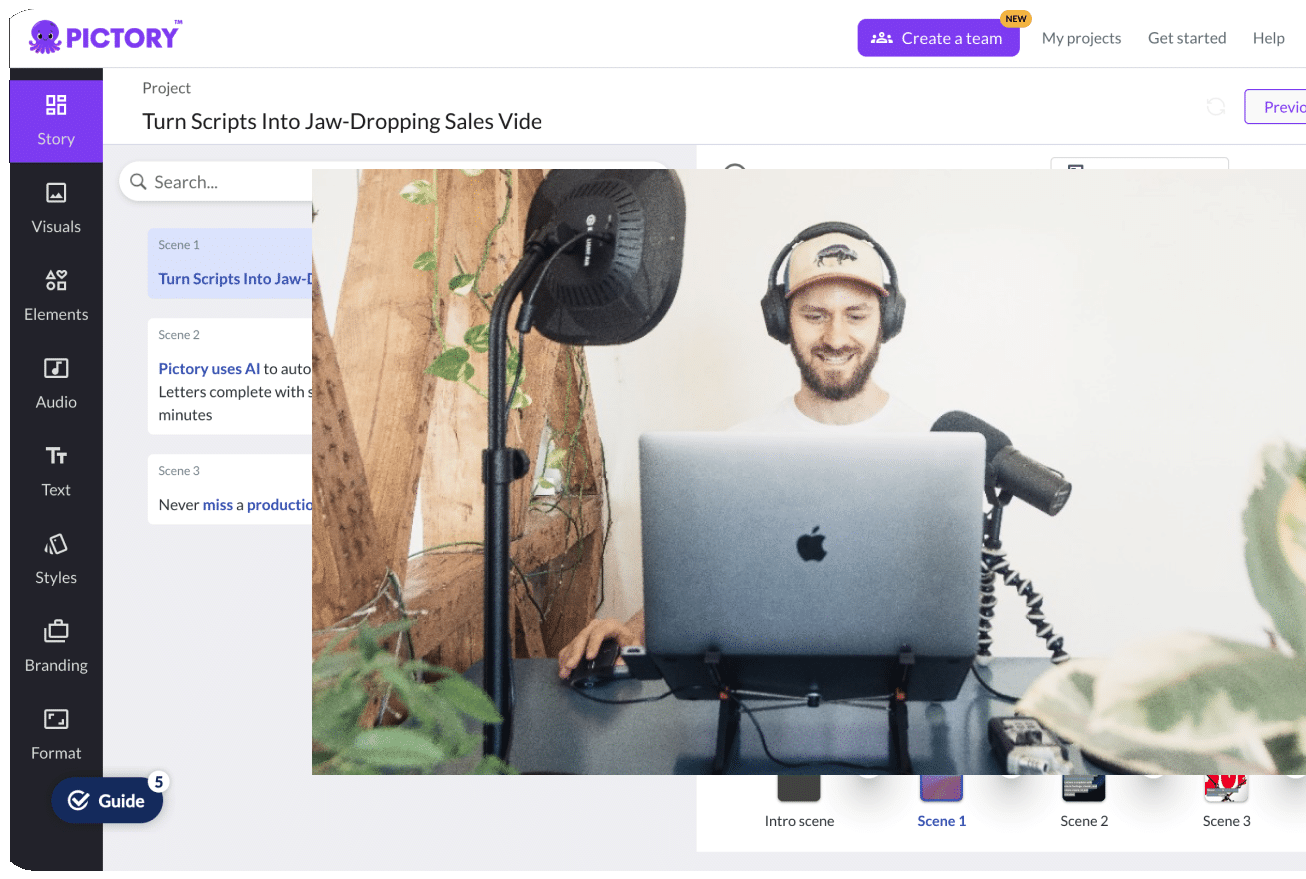
You don’t need to write from scratch. A policy document, a training guide, a slide deck, or a bullet-point outline is enough. Pictory’s Script to Video and PPT to Video tools take what you already have and build from it.
Let AI break it into scenes
Pictory reads your text and splits it into timed segments, each matched to a relevant visual from a library of millions of licensed clips from Getty Images and Storyblocks. You review and swap out anything that doesn’t fit.
Choose a voiceover or add an avatar
Pick from hundreds of AI voices powered by ElevenLabs, upload your own recorded voiceover, or add an AI avatar as the on-screen presenter. The Avatar Clone feature lets L&D leads record themselves once and reuse their likeness across every module.
Apply your brand kit
Pictory drops in your organisation’s logo, colours, and fonts automatically. Every training video looks like it was produced by the same team, even when multiple people are creating content independently.
Generate captions and export
Auto-captions are generated and synced. Export your video and publish to your LMS, SharePoint, or internal training portal. Pictory integrates with Zapier and Make for automated workflows.
Update instantly when content changes
Edit the script and regenerate. No re-recording, no production delay. Your training library stays accurate without a production sprint every quarter.
How long should AI training videos be?
Shorter is almost always better for retention. Research from Deloitte found that organisations using microlearning report 50% faster skill development compared to traditional programmes. The target for most corporate training modules is two to five minutes per topic.
80–90%
completion rate for short-form training modules vs 30% for long-form eLearning
50%
faster skill development with microlearning vs traditional formats — Deloitte, 2025
218%
higher income per employee at companies with strong training programmes
91%
of companies plan to increase AI spending in L&D in 2026 — WhatFix
The rule of thumb: one concept per video, three to five minutes maximum. If you’re covering a topic that needs more depth, break it into a series of short modules rather than one long video.
What makes AI training videos actually effective?
Production quality matters less than clarity and pacing. Here’s what L&D teams should prioritise when building their training video library.
One topic per video
Focused content completes faster and retains better. Never try to cover everything in one module.
Always include captions
85% of mobile videos are watched without sound. Captions make your training accessible and replayable.
Version and date your modules
Policies change. Show the version date in the video so learners know they’re watching current content.
Build a series, not a course
A library of short, searchable clips beats one hour-long course every time. Learners find what they need and move on.
Enterprise training video at scale: what changes
For larger L&D teams and global organisations, the production challenge shifts from “how do we make one video?” to “how do we keep 50 videos current and consistent?” Pictory’s brand kit and team collaboration features address this directly — every team member produces from the same template, with the same logo, colours, and voice style.
The multilingual voiceover feature covers 29 languages, which means your onboarding programme can be localised without re-recording. Build the content once in English, publish it in French, German, Spanish, or any of the other supported languages with the same AI voice quality.
For enterprise L&D deployments, the Pictory Enterprise plan includes team controls, custom integrations, and dedicated support. Security details are at pictory-corp.trust.site.
Start building your training video library today
Turn your existing training documents into polished video in minutes — no camera, no editor required.
The bottom line on AI training video for L&D teams
The production barrier that kept most L&D teams from building a proper video library is gone. What used to take a freelance videographer and four weeks now takes a script and an afternoon. The teams winning in L&D in 2026 aren’t those with the biggest production budgets — they’re the ones who figured out how to produce consistent, clear, replayable content at the speed their organisation actually needs it.
If your training content is still living in slide decks and PDFs, it’s time to convert it. Your learners will thank you — and your completion rates will too.
FAQ: Making Training Videos with AI
What is an AI training video?
An AI training video is a corporate learning module produced using text-to-video tools, AI voiceovers, and optional avatar presenters . You supply a script or document; Pictory builds the video — matching visuals, generating narration, adding captions.
How long does it take to make a training video with AI?
Most two to five minute training videos can be produced in 20 to 45 minutes using Pictory, from pasting your script to exporting the finished file. Compare that to the two to four week production cycle for traditional filmed training content. Updates take under 10 minutes — you edit the script and regenerate.
Do AI training videos work for compliance content?
Yes, and they work better than static documents. 89% of employees find microlearning more engaging for compliance topics specifically, according to EdApp research. Short, watchable compliance videos get completed. Long PDFs get skimmed or skipped. Video also gives you a consistent delivery that’s auditable across your entire workforce.
Can I create training videos in multiple languages?
Yes. Pictory’s multilingual voiceover feature supports 29 languages. Build your training module once in English and publish it across all your markets without re-recording anything. The AI voice quality is consistent across all language versions.
How do I update training videos when policies change?
In Pictory, you edit the script text and regenerate the video. No re-recording, no new production, no waiting. Most policy updates take under 10 minutes to reflect in your video. With filmed video, a policy change means a full reshoot. With Pictory, it\’s a script edit and a regenerate.

![[Article] How AI Is Changing eLearning Video Production for L&D Teams in 2026](https://pictory.ai/wp-content/uploads/2026/06/eLearning-Video-Production-300x200.webp)