

![[Article] - Pictory vs HeyGen: Which AI Video Platform Is Right for You? (2026)](https://pictory.ai/wp-content/uploads/2026/06/pictory-vs-heygen-thumbnail.webp)
TL;DR
Pictory is the better fit for content teams that repurpose existing material at scale: blogs, recordings, podcasts, presentations, and screen captures all processed inside one platform, with avatar clones, voice cloning, interactive video hosting, and a full developer API included. For most marketing and L&D teams, Pictory delivers more workflow coverage at a significantly lower cost per video.
Pictory and HeyGen both make professional video without a camera or studio. The difference is what they’re built around. HeyGen is organized entirely around one question: how do you put a convincing, lip-synced human presenter on screen? Pictory starts with what you already have, a blog post, a recording, a slide deck, a podcast, and turns it into video. Which one you need depends on which problem you’re actually trying to solve.
What Is Each Platform Built For?
HeyGen produces one type of output: a video with a presenter on screen. You write a script, choose or create an avatar, and HeyGen generates a talking-head video with your avatar delivering the script in a chosen language. It also translates existing videos into 40+ languages with matching lip sync, which drives most of its enterprise use. If maximum avatar realism and language coverage is the requirement, HeyGen is the tool for that job.
Pictory converts source material into video. You bring a blog URL, an audio file, a recording, a slide deck, or images, and Pictory builds a structured, branded video from it. Avatars are one presentation option; most Pictory videos use stock footage or AI-generated visuals. The platform covers the full production pipeline: AI scripting, scene building, voiceover, captions, brand styling, and interactive video publishing via Pictory Central.
Pictory vs HeyGen: Feature-by-Feature Comparison
| Feature | Pictory | HeyGen | Winner |
|---|---|---|---|
| Blog/URL to video | Native: extracts key sentences, matches stock footage | Not available | Pictory |
| Audio/podcast to video | Native: transcribes, builds storyboard, matches visuals | Not available | Pictory |
| PPT to video | Native (up to 90 slides) | Not available | Pictory |
| Screen recorder | Built-in screen + camera recorder | Not available | Pictory |
| AI avatar quality | Good: full library, per-scene control | Best-in-class: Avatar V, micro-expressions, gesture timing | HeyGen |
| Avatar Clone (your likeness) | Yes, photo + video + voice sample; 35 credits/30 sec | Yes, Instant Avatar from 2 minutes of footage (Pro+) | Tie |
| Voice cloning | Yes, personal voice clone across all workflows | Yes, voice clone included in translated videos | Tie |
| Video translation with lip sync | Multilingual voiceover (29 languages, Pro+) | 175+ languages, industry-leading lip-synced dubbing | HeyGen |
| AI image generation | AI Studio: 5 models including Veo 3.1 and Flux Schnell | Generative B-roll (uses premium credits) | Pictory |
| AI video generation | Pixverse (720p), Veo 3.1 Fast + Veo 3.1 (1080p) | Limited: B-roll generation only | Pictory |
| Brand Kits | 1-10 kits; logo, fonts, colors, style presets | Yes, brand colors and templates | Tie |
| Auto captions | Auto-generated, fully styleable, 29+ languages | Yes, captions included | Tie |
| Interactive video hosting | Pictory Central: quizzes, CTAs, chapters, SCORM (Teams/Enterprise) | SCORM export (Business+); no native quiz or CTA layer | Pictory |
| Developer API | Full API: text, URL, PPT, captions, Brand Kit, MCP Server | API available on Pro+: Video Gen, Translation, Text to Speech | Tie* |
| No-code integrations | Zapier, Make | Zapier, HubSpot, Make, n8n (Business+) | HeyGen |
| Credit/minute rollover | AI Credits roll over and never expire | Credits reset monthly; unused credits lost on cancellation | Pictory |
| Starting price (annual) | $19/month (Starter) | $24/month (Creator) | Pictory |
| Free tier | 14-day trial, full features, watermarked | Free plan: 3 videos/month, 1 min max, watermarked, 720p | Tie |
* API comparison: Pictory’s API covers all content repurposing workflows including brand kits and MCP Server orchestration. HeyGen’s API covers avatar video generation, translation, and text to speech, which is stronger for avatar-specific pipelines.
How Does the Editing Experience Compare?
HeyGen’s editor is organized around scripts and avatars. You write or paste a script, assign it to an avatar, choose a background, and render. The AI Studio editor includes 75+ templates for layout and branding, and the Video Agent feature automates the full script-to-video pipeline from a single text prompt. For avatar-focused video, it’s a clean, fast workflow.
Where HeyGen narrows is anything outside the avatar use case. There’s no scene-based repurposing editor, no URL-to-storyboard pipeline, and no transcript editing for long recordings. Upload a 45-minute webinar to HeyGen and you’re largely on your own deciding what to do with it. Upload the same recording to Pictory and the Auto Highlight feature scans the transcript, surfaces the strongest moments, and builds clips without manual scrubbing.
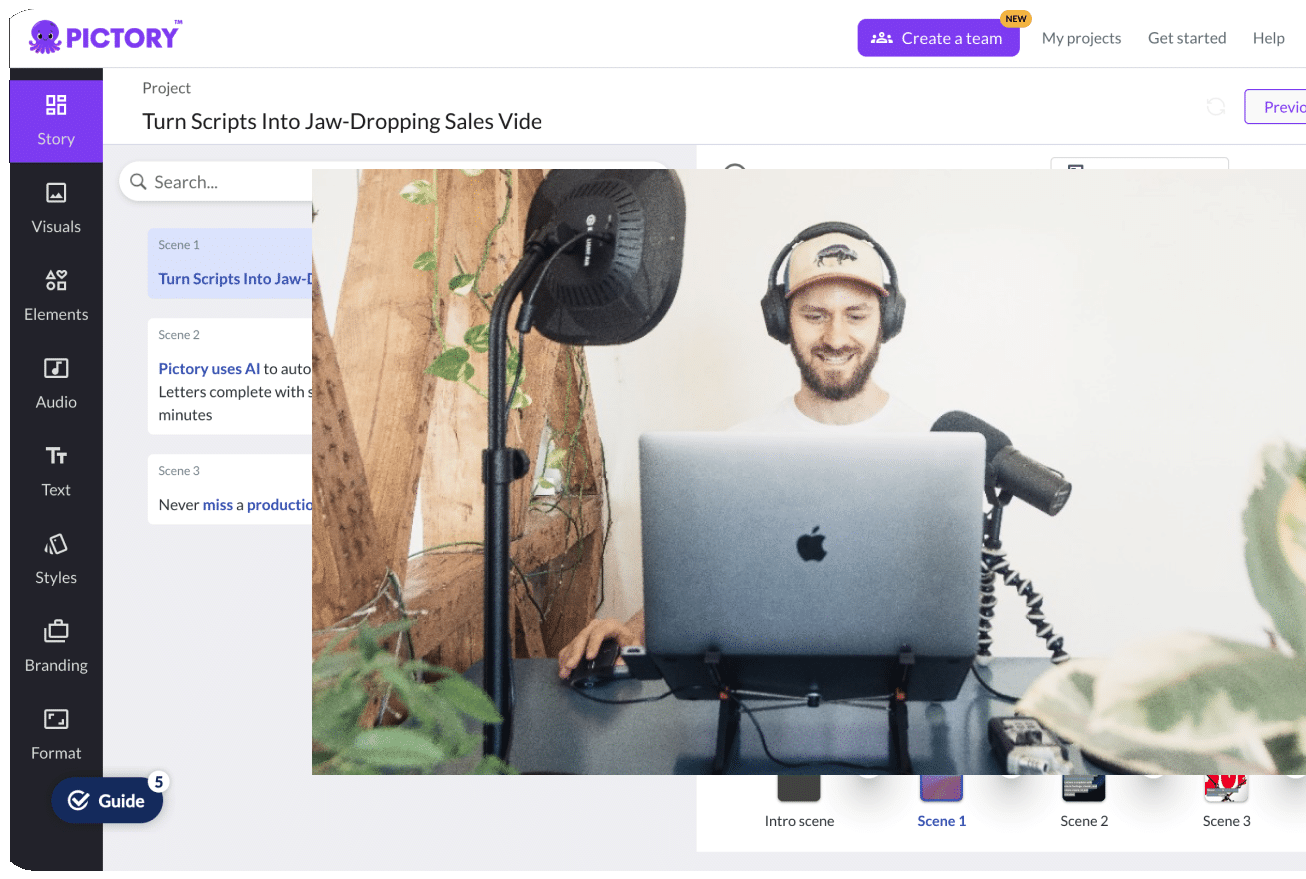
Pictory’s scene-based editor handles the full production workflow: left panel for script and scene text, right panel for live preview, a bottom thumbnail timeline, and sidebar tabs for visuals, audio, text, branding, and avatars. The Subtitles and Captions Academy guide covers caption customisation. The AI Studio guide covers generating custom visuals for any scene.
How Does HeyGen’s Avatar Technology Compare to Pictory’s?
If avatar quality is what you’re deciding on, HeyGen wins. The Avatar V model produces the most photorealistic AI avatar video on any platform in 2026. Face-similarity scores from third-party benchmarks put it at the top of the category, and the combination of expression timing and accurate lip sync makes short clips under 90 seconds hold up to scrutiny. For corporate training, executive communications, or product demos where a visible, credible presenter matters, HeyGen is the right tool.
Pictory’s Avatar Clone feature, launched May 2026, builds a digital twin from a photo or short video clip plus a voice sample. The clone narrates scripts across all Pictory workflows, not just standalone avatar videos. Your cloned presenter can appear in a blog-to-video, a PPT-to-video, or an audio-to-video project without additional recording. Avatar Clones cost 35 AI Credits per 30 seconds; stock avatars from the Pictory library cost 15 credits per 30 seconds, as confirmed in the Pictory AI Credits Help Center.
The practical choice: if standalone avatar video with maximum realism is the core deliverable, use HeyGen. If your avatar needs to appear inside a broader content repurposing workflow, narrating a video built from a blog post or a podcast recording, Pictory’s Avatar Clone is the more integrated option.
How Does HeyGen’s Video Translation Compare to Pictory’s Multilingual Support?
This is where HeyGen has a real and substantial lead. HeyGen’s lip-sync translation engine, upgraded in HeyGen 5.0, takes any source video and produces localized versions where the presenter’s mouth movements match the translated audio in 40+ languages, with audio-only dubbing available in 175+ languages. The system preserves the presenter’s vocal tone through voice cloning in the translated version. For teams localizing training materials, product demos, or marketing content across regions, this feature alone can justify HeyGen’s subscription cost.
Pictory supports multilingual voiceover on the Professional plan and above, covering 29 languages through its ElevenLabs integration and AI voice library. The Multilingual Voiceovers Academy guide covers the full setup. Pictory’s multilingual support works well for teams producing content in a second language or generating voiceovers for non-English markets. What it doesn’t do is take an existing English-language video and produce a lip-synced Spanish version with matching mouth movements. That’s HeyGen’s specialist capability, and Pictory doesn’t compete with it directly.
LANGUAGE AND TRANSLATION: QUICK COMPARISON
| Feature | Pictory | HeyGen |
|---|---|---|
| Multilingual voiceover | ✓ 29 languages (Pro+), ElevenLabs voices | ✓ 175+ languages |
| Lip-sync video translation | ✗ Not available | ✓ 40+ languages, mouth movements matched |
| Audio-only dubbing | ✓ Via ElevenLabs voiceover | ✓ 175+ languages, unlimited on paid plans |
| Voice cloning in translation | ✓ Personal voice clone across workflows | ✓ Speaker voice cloned in translated video |
How Does Pricing Compare Between Pictory and HeyGen?
Both platforms start at a similar price point on annual billing, but the credit systems work very differently in practice.
PRICING COMPARISON (ANNUAL BILLING)
| Plan | Pictory | HeyGen |
|---|---|---|
| Entry paid | $19/mo: 200 video mins, 1080p, ElevenLabs voiceover, Getty + Storyblocks, 1 brand kit | $24/mo (Creator): unlimited videos, 15 min premium avatar video/mo, Avatar V, 175 languages |
| Mid-tier | $35/mo (Professional): 600 video mins, 5 brand kits, 29 languages, 500 AI credits | $79/mo (Pro): 30 min premium avatar video/mo, API access, 3 seats, SCORM export |
| Business/Teams | $119/mo (Teams, 3+ users): 1,800 mins, shared brand kits, Pictory Central | $124/mo (Business, annual): 60 min premium video, 5 custom avatars, SSO, 4K, Zapier/HubSpot/Make/n8n |
| Enterprise | Custom: SSO, done-for-you video, Pictory Central, full API | Custom: unlimited digital twins, dedicated support, SLA |
The credit math is where the HeyGen comparison gets important. HeyGen’s Creator plan advertises “unlimited videos” but caps Avatar V, the photorealistic model most users actually want, to premium credits covering roughly 15 minutes of avatar video per month. For a team producing four to six short training videos weekly, that ceiling arrives in the first week. Upgrading to Pro at $79 per month doubles the allowance to 30 minutes. Teams that need more buy additional credit packs.
HeyGen’s credits do not roll over on monthly plans. On annual plans, they accumulate until renewal. After cancellation, credits are forfeited. eesel AI, June 2026
Pictory’s AI Credits roll over month to month and never expire while your subscription is active, as confirmed in the Pictory Help Center. On the Teams plan, credits are pooled across the workspace, so the whole team draws from one shared balance. For teams whose production volume varies, a campaign-heavy quarter followed by a quieter period, Pictory’s credit system removes the pressure to produce just to use up the allowance before it resets.
What Generative AI Models Does Pictory Use?
HeyGen’s generative capability focuses on avatar video and offers generative B-roll as a secondary feature, with B-roll generation consuming premium credits. Pictory’s AI Studio gives you direct access to a broader model stack for both image and video generation, all billed from the same shared credit pool.
PICTORY AI STUDIO: CURRENT MODELS
| Model | Type | AI Credits |
|---|---|---|
| Flux Schnell | Image (1920×1080) | 0.6 per image |
| Amazon Titan G1 | Image | 0.7 per image |
| ByteDance Seedream | Image | 2 per image |
| Google Nano Banana | Image | 4 per image |
| Amazon Nova Canvas | Image | 4 per image |
| Pixverse | Video (720p) | 1.6 per second |
| Veo 3.1 Fast | Video (1080p) | 10 per second |
| Veo 3.1 | Video (1080p, full quality) | 20 per second |
Credit rates and model availability are sourced from the Pictory AI Credits Help Center. All credits are shared across the workspace on Teams plans, roll over monthly, and never expire.
Does Pictory or HeyGen Have Better Interactive Video and API Support?
Both platforms offer developer APIs and SCORM export for L&D teams, but they approach interactive video differently.
HeyGen’s API covers avatar video generation, video translation, text to speech, and template operations, available on the Pro plan and above. SCORM export arrived on the Business plan in 2026, having previously been restricted to Enterprise. Native integrations for Zapier, HubSpot, Make, and n8n are included on the Business plan. For teams building automated avatar video pipelines, HeyGen’s API is well-documented and purpose-built for that use case.
Pictory Central builds a full interactive layer on top of your video. AI generates chapter markers automatically. Quizzes are built from video content without manual question writing. Clickable in-video CTAs appear at specific moments. Every interactive element is packaged into SCORM for direct LMS upload. The Pictory Central Academy guide covers the full setup. HeyGen exports SCORM video files but doesn’t add an interactive layer inside the video itself.
The Pictory API supports text to video, URL to video, PPT to video, video summarisation, and caption generation as callable endpoints, with a Brand Kit API included so programmatic output inherits your branding automatically. The Pictory MCP Server allows AI assistants to orchestrate the full video production pipeline through natural language. Pictory is SOC 2, GDPR, and ISO 27001 certified; HeyGen is GDPR and SOC 2 compliant.
✓ GDPR Compliant
✓ ISO 27001 Certified
Looking for a HeyGen Alternative?
If you’re using HeyGen and finding that the credit cap cuts off your production before the month is out, or that most of what you actually need to make isn’t avatar video, Pictory is worth a direct look.
Most marketing and L&D teams spend the majority of their time repurposing content they already have: turning a blog post into a short video, clipping a webinar into social content, converting a slide deck into a narrated training module. HeyGen doesn’t handle any of those workflows. Pictory does all of them, in one platform, with credits that roll over rather than reset.
The URL to Video workflow turns any blog post or article into a captioned, narrated video in minutes. Avatar Clones let you add a consistent on-screen presenter to any video type, not just scripted talking-head content. And the Avatar Clones Academy guide walks through the full setup from photo to finished video. Try Pictory free for 14 days and run your most common content format through it first.
TRY PICTORY
Turn your content into video in minutes
Blog posts, recordings, slide decks, podcasts. Pictory handles all of it with avatars, voice cloning, AI-generated visuals, and interactive video built in.
Our Verdict
Pick HeyGen when your primary need is a photorealistic talking-head presenter or lip-synced translation across languages. If your team produces corporate communications, product demos, or training content where a visible, credible on-screen presenter matters, HeyGen’s Avatar V model and translation engine are the best tools for that specific job. The Business plan at $124 per month annual, which adds SCORM export and the HubSpot, Make, and n8n integrations, is where HeyGen makes sense for structured L&D teams.
The real constraint with HeyGen is volume and breadth. The credit system caps most Creator plan users at 15 minutes of premium avatar video per month. Credits reset monthly and are forfeited on cancellation. Outside the avatar use case, HeyGen doesn’t cover the content repurposing workflows that most marketing and L&D teams spend the majority of their time on: turning blog posts into video, clipping podcast recordings, converting webinar footage into short-form content, or building a narrated training library from existing presentation materials.
Pictory covers all of those workflows, costs less at every equivalent tier, includes a credit system that rolls over rather than resets, and adds Avatar Clones, interactive video hosting via Pictory Central, and a full developer API with MCP Server support. For content teams that need to produce a diverse range of video types consistently, Pictory delivers more output per dollar.
See how Pictory handles your workflow
Start a 14-day free trial. No credit card required. Put your most common content format through it and see the output for yourself.
FAQ: Pictory vs HeyGen
Is HeyGen better than Pictory for AI avatar videos?
Yes, if photorealistic avatar quality is what you need. HeyGen’s Avatar V model produces the most convincing AI talking-head video available in 2026, with accurate lip sync that holds up in short clips. Pictory’s Avatar Clone feature works well for integrating a presenter inside broader content repurposing workflows but doesn’t match HeyGen’s avatar realism.
Can Pictory translate video into multiple languages like HeyGen?
Partially. Pictory supports multilingual voiceover in 29 languages on the Professional plan through its ElevenLabs integration. What Pictory doesn’t offer is lip-synced video translation, where an existing video’s presenter mouth movements are re-rendered to match translated audio. That’s HeyGen’s specialist capability and it covers 40+ languages with full lip sync and 175+ languages with audio dubbing.
Why do HeyGen’s credits run out so fast?
HeyGen’s “unlimited video” marketing refers to total video output, not premium avatar quality. Avatar V, the photorealistic model most users want, consumes 20 premium credits per minute. The Creator plan covers roughly 15 minutes of Avatar V video per month. Producing more than four or five short videos monthly puts most teams at the limit. Credits also reset monthly with no rollover, so unused allowance is lost.
Does Pictory have SCORM export for LMS integration?
Yes. SCORM export is available through Pictory Central on the Teams and Enterprise plans. Pictory Central also adds AI-generated quizzes, in-video CTAs, and automatic chapter markers, an interactive layer that HeyGen doesn’t offer inside the video experience itself. HeyGen’s SCORM export on the Business plan produces a standard video file in SCORM format without these interactive elements.
Which tool is better for content marketing teams?
Pictory, in most cases. Content marketing teams that need to repurpose blog posts, podcast recordings, webinars, and presentations into video at scale will find Pictory’s workflow coverage much broader than HeyGen’s. HeyGen is better suited to teams whose primary output is scripted talking-head video or multilingual video localisation, rather than high-volume content repurposing across formats.