

TL;DR
Pictory and InVideo both turn text into video, but they’re built for different jobs. Pictory is the faster choice for repurposing blogs, scripts, and long-form content into polished video. InVideo gives you a broader creative canvas with thousands of templates and granular editing tools. This guide breaks down where each tool wins so you can pick the right one for your workflow and budget.
Choosing between Pictory and InVideo in 2026 isn’t about which tool is better overall. It’s about which one fits the way you actually work. Both platforms can take text and produce a watchable, professional video. Both have AI voiceover, stock footage libraries, and plans that cost roughly the same per month. But under the surface, they’re solving two very different problems.
What Is Each Tool Built For?
Pictory is a content repurposing engine. You start with something you’ve already made, a blog post, a script, a webinar recording, a PowerPoint deck, and Pictory turns it into a video. The AI reads your content, breaks it into scenes, matches stock footage to each one, adds captions, and generates a voiceover. You spend most of your time reviewing and refining, not building from scratch.
InVideo is a creation platform. You start with a prompt or a template and build outward. The editor feels closer to a traditional video tool, with a timeline, clip swapping, transition controls, and thousands of layout options. It’s useful for marketers who want to craft specific-looking content for paid ads, social media campaigns, or brand videos where every design decision matters.
Independent testing shows Pictory turned an 800-word blog post into a captioned, narrated video in under four minutes, with scene breaks that matched the original article structure. Pexo, 2026
That split, repurposing versus creating, drives almost every difference between these two platforms. Keep it in mind as you work through the comparison below.
Pictory vs InVideo: Feature-by-Feature Comparison
| Feature | Pictory | InVideo | Winner |
|---|---|---|---|
| Blog/URL to video | Native, highly accurate | Prompt-based, less faithful to source | Pictory |
| PPT to video | Native (up to 90 slides) | Not available | Pictory |
| Audio/video to video | Native transcription + editor | Limited | Pictory |
| Template library | ~100 curated layouts | 10,000+ templates | InVideo |
| Auto captions / subtitles | 95%+ accuracy, 29 languages (Pro) | Good, 60+ languages | Pictory |
| AI voiceover | ElevenLabs (Pro+), 80+ voices | 60+ voices, voice cloning (Max) | Tie |
| Brand Kits | Up to 5 (Pro) / per user (Teams) | Yes (paid plans) | Tie |
| Screen recorder | Built-in (screen + camera) | Not available | Pictory |
| AI image/video generation | AI Studio (prompt to image/video) | Sora 2 + VEO 3.1 (Generative plan) | InVideo |
| AI avatars (stock) | Library of digital presenters, lip-sync on export, shown/hidden per scene | UGC-style AI actors, multi-avatar per video | Tie |
| Avatar Clones (your likeness) | Yes, upload a photo, video and voice sample to build your own digital twin | Yes, via the AI Twins feature | Tie |
| Voice Cloning | Yes, clone your voice via AI Studio; used across all workflows | Yes, up to 2 clones (Plus), 5 clones (Max) | Tie |
| Team collaboration | Yes (Teams plan) | Yes (paid plans) | Tie |
| Editing style | Scene-based, AI-automated | Timeline-based, manual control | Depends on workflow |
| API access | Full developer API: text, URL, PPT, video summarization, Zapier, Make, MCP Server | Limited API, Zapier | Pictory |
| Interactive video hosting | Pictory Central: quizzes, CTAs, chapters, SCORM (Teams/Enterprise) | Not available | Pictory |
| Free tier | 14-day trial (full features, watermarked) | Free forever (watermarked, 10 min/week) | InVideo |
How Does the Editing Experience Compare?
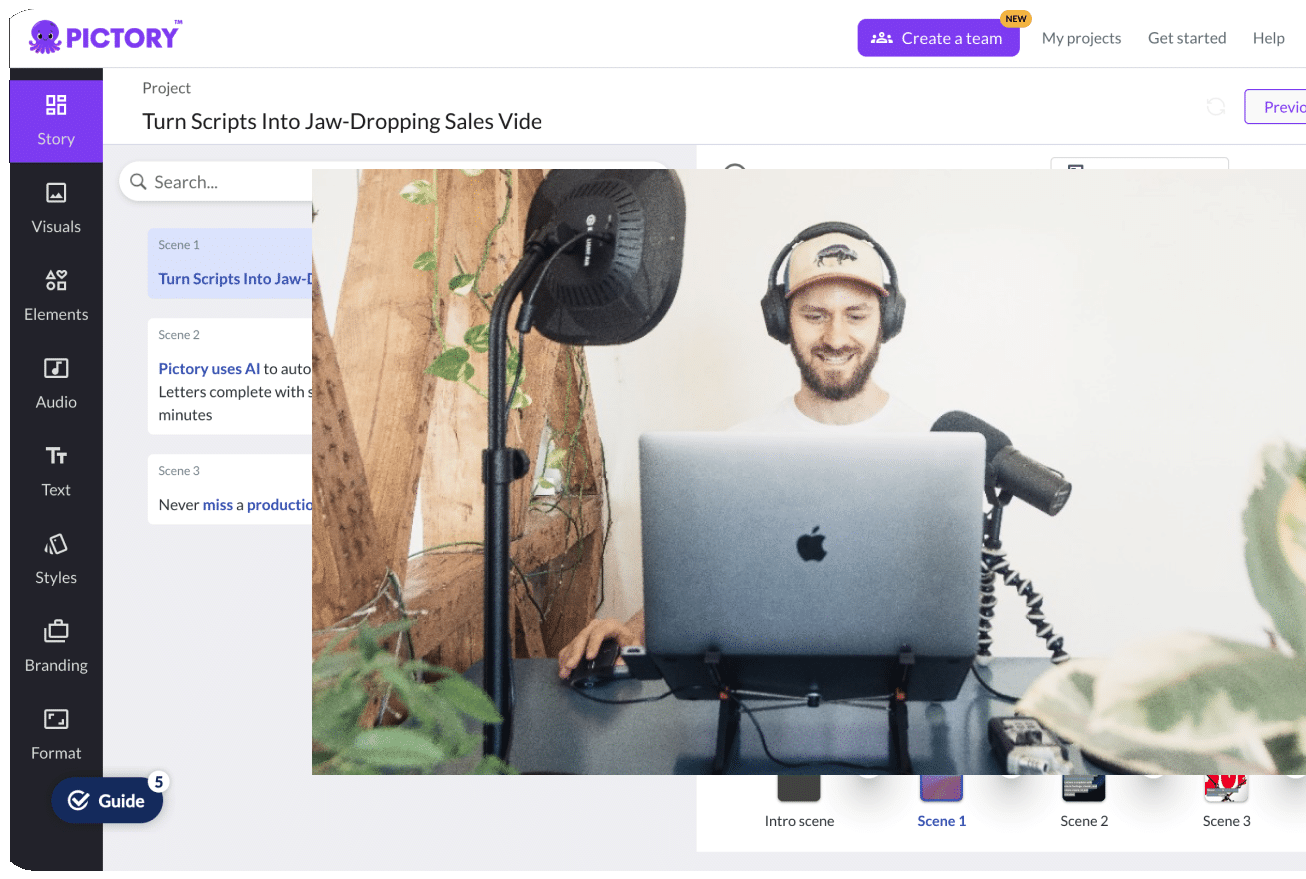
Pictory’s AI video editor is scene-based. Your script or content gets broken into individual scenes, and you edit text, swap visuals, and adjust timing one scene at a time. There’s no traditional timeline to drag clips around. That’s intentional: the goal is to get you from content to finished video with the fewest decisions possible.
The editor includes a left-side story panel for script editing, a visual panel pulling from Getty Images, Storyblocks, and Pictory’s AI Studio for generated images, a right-side preview, and a bottom thumbnail timeline. Subtitles are generated automatically and can be styled, repositioned, and animated. The Subtitles and Captions Academy guide covers every customisation option. Text animations, brand colors, fonts, and layout styles all apply across scenes in seconds.
InVideo operates more like a traditional video editor. You pick a template, then work through a timeline with individual clips, transitions, and text layers. If you enjoy the editing process and want granular control over every visual decision, InVideo suits that preference. If you’d rather let AI handle the heavy lifting while you review and refine, Pictory’s workflow gets you there faster.
Which Tool Handles Content Repurposing Better?
Pictory wins this category outright. Paste a blog URL and it pulls the core sentences, matches stock footage to the content, adds subtitles, and generates a voiceover. The same workflow applies to audio files, webinar recordings, PowerPoint decks, and images. Every URL to Video, Audio to Video, and PPT to Video workflow runs natively inside Pictory with step-by-step Academy guides to get you started fast.
InVideo can technically import text, but it generates a new script inspired by your input rather than extracting directly from it. Key points get reordered, reworded, or supplemented by the AI. If you need the final video to stay faithful to your original article or recording, Pictory is the more reliable tool. One independent review scored Pictory 8 out of 10 for content fidelity and InVideo 6 out of 10 for the same task.
Pictory also generates automatic video highlights from long recordings, which cuts the editing work for podcasters and webinar teams turning long-form content into short social clips. The Auto Highlight feature scans your transcript, identifies key phrases and high-value moments, and turns them into individual clips without any manual scrubbing. The full Auto Highlight guide in Pictory Academy walks through every step.
How Do Pictory and InVideo Handle Branding?
Both tools support Brand Kits, but Pictory’s implementation is built for content teams that need to maintain consistent branding across dozens of videos a month. Brand Kits in Pictory store your logo, custom fonts, color palette, and style presets. Apply one to your project and every scene inherits those settings instantly. Professional plan users get five brand kits, and Teams plan users get brand kits per seat, which works well for agencies managing multiple client accounts. The Brand Kits Academy guide covers setting up logos, custom colors, and fonts from scratch.
InVideo also supports brand kits, but the editor’s template-driven nature means you often spend more time manually aligning designs to your brand look. For teams publishing high volumes of consistent video, Pictory’s automation advantage compounds over time.
What Generative AI Models Does Pictory Use?
This is where the comparison gets interesting for teams that care about AI-generated visuals. Pictory’s AI Studio gives you access to a range of image and video generation models, each consuming a different number of AI Credits. You’re not locked into one model. You choose based on speed, quality, and how many credits you want to spend.
For image generation, the current model lineup runs from fast and economical to high-fidelity:
| Image model (1920×1080) | AI Credits per image |
|---|---|
| Flux Schnell | 0.6 |
| Amazon Titan G1 | 0.7 |
| ByteDance Seedream | 2 |
| Google Nano Banana | 4 |
| Amazon Nova Canvas | 4 |
For video generation, Pictory includes Google’s Veo 3.1 at 1080p, available in a fast mode and a full-quality mode:
| Video model | AI Credits per second of video |
|---|---|
| Pixverse (720p) | 1.6 |
| Veo 3.1 Fast (1080p) | 10 |
| Veo 3.1 (1080p) | 20 |
AI Avatars also draw from the same credit pool. Stock avatars cost 15 credits per 30 seconds of video, and Custom Avatars, built from your own likeness, cost 35 credits per 30 seconds.
Unused AI Credits roll over to the next billing cycle and never expire while your subscription is active. Credits are pooled at the workspace level on the Teams plan, so the whole team draws from one shared balance. Pictory Help Center
That credit-based model sits in contrast to InVideo’s approach. InVideo’s AI generation minutes are capped per month and don’t roll over, which means a heavy week of generation can leave you short for the rest of the billing period. Pictory’s rollover policy removes that pressure for teams whose output varies month to month.
How Do Pictory and InVideo Compare on Avatars and Voice Cloning?
Avatar and voice cloning are now a real point of difference between AI video platforms, and both Pictory and InVideo offer them, but with different approaches and different depths of customisation.
Stock AI Avatars
Pictory’s avatar library gives you a range of digital presenters that sit as an editable layer inside any video project. You can resize them, reposition them, show or hide them per scene, change their outfit and framing, and pair them with any AI voice from the Audio tab. Lip-sync is generated automatically when you export, with no extra steps required. The full workflow is covered in the AI Avatars Academy guide.
InVideo offers UGC-style AI actors designed to produce direct-to-camera, informal content that performs on TikTok and Instagram. The aesthetic leans consumer rather than corporate, which suits performance marketers but may feel off-brand for training or B2B content.
Avatar Clones: Using Your Own Likeness
Pictory’s Avatar Clone feature, launched in May 2026, lets you create a digital twin from your own photo, video footage, and voice sample. Once built, the clone narrates your scripts across as many videos as you need. That’s useful for training teams building a library of onboarding modules, course creators producing a series, or marketers who want a consistent presenter across campaigns without recurring recording sessions.
Avatar Clones draw from the AI Credits pool. Custom Avatar generation costs 35 credits per 30 seconds of video, compared to 15 credits per 30 seconds for stock avatars. Credits roll over and never expire with an active subscription, as confirmed in Pictory’s Help Center, so teams can bank credits across quieter months and deploy them when production ramps up.
Voice Cloning
Pictory’s voice cloning lets you capture your own voice and use it across all video workflows, not just avatar videos. That matters for creators who want narration to sound consistent whether the video was built from a blog URL, a script, an audio file, or a PPT. The cloned voice works with Pictory’s Auto Sync feature, which aligns the audio to scene timing automatically.
InVideo offers voice cloning on its Max plan with up to five clones, which suits agencies maintaining distinct audio brands across multiple client channels. Pictory’s voice cloning currently focuses on a single personal voice clone, making it the better fit for solo creators and internal teams rather than agencies managing several different client voices.
AVATAR AND VOICE CLONE: QUICK COMPARISON
| Feature | Pictory | InVideo |
|---|---|---|
| Stock AI avatars | ✓ Library of digital presenters | ✓ UGC-style AI actors |
| Avatar Clone (your likeness) | ✓ Photo + video + voice upload | ✓ AI Twins feature |
| Voice cloning | ✓ Personal voice clone, works across all workflows | ✓ 2 clones (Plus) / 5 clones (Max) |
| Avatar credit cost | 15 credits / 30 sec (stock); 35 credits / 30 sec (clone) | Included in generation minutes |
| Credit rollover | ✓ Unused credits roll over; never expire | ✗ Minutes don’t roll over |
| Lip-sync | Auto-generated on export | Auto-generated |
| Best for | Training, L&D, course creators, consistent presenter across series | UGC ads, social content, multi-client voice brands |
What Are the Pricing Differences?
Both tools start at a similar price point, but they structure their plans differently.
Pictory’s Starter plan runs $25 per month (or $19 per month billed annually) and includes 200 video minutes, access to Getty Images and Storyblocks, one brand kit, and AI voiceover. The Professional plan at $35 per month annually adds 600 video minutes, ElevenLabs AI voices, five brand kits, 500 generative AI credits, and support for 29 languages. The Teams plan at $119 per month covers three users with 1,800 minutes and collaboration features. Start a free trial to explore all plan features.
InVideo’s Plus plan costs around $25 per month (or $20 on annual billing) and includes 50 AI generation minutes, 80 iStock downloads, and two voice clones. The Max plan at $60 per month monthly adds 200 AI minutes, 4K export, five voice clones, and 320 iStock assets per month. A premium Generative tier at $120 per month bundles access to Sora 2 and VEO 3.1 for creators who need AI-generated footage rather than stock clips.
One important difference: InVideo’s free tier is a permanent free plan with 10 AI minutes per week and watermarked exports. Pictory offers a 14-day free trial with access to all features but no permanent free option. If you need more time to evaluate before committing, InVideo gives you more runway.
For high-volume content repurposing, Pictory’s Professional plan at $35 per month covers a substantial output. For teams that need 4K export, AI-generated footage, or a larger template library for varied creative work, InVideo’s Max or Generative plans make more sense.
What Is Pictory Central, and Does InVideo Have an Equivalent?
Pictory Central is Pictory’s interactive video hosting layer, included in the Teams and Enterprise plans. Once you’ve created a video, Pictory Central lets you publish it as an interactive experience rather than a passive watch. InVideo has no equivalent feature.
PICTORY CENTRAL: WHAT IT DOES
Auto chapters
AI detects topic changes and creates structured navigation automatically.
AI-generated quizzes
Quizzes and knowledge checks created from video content automatically.
In-video CTAs
Clickable buttons and links inserted at specific moments in the video.
SCORM export
Export interactive videos straight into any LMS without additional infrastructure.
Video hosting
Host and stream video directly through Pictory without a separate platform.
For training teams, L&D departments, and educators, Pictory Central removes a significant integration headache. Most teams building AI video for learning currently stitch together a video creation tool, a hosting platform, a quiz builder, and an LMS export step. Pictory Central puts all four inside a single subscription. The Pictory Central Academy guide covers the full setup, and the PPT to Video with Quiz guide shows how to go from a PowerPoint slide deck to a SCORM-ready interactive training module in one workflow.
InVideo doesn’t offer interactive video hosting, SCORM export, or in-video quizzes. If those features are part of your workflow, or likely to be, Pictory is the clear choice.
Does Pictory Have an API? How Does That Compare to InVideo?
Pictory offers a full developer API that lets teams embed AI video creation directly into their existing tools and platforms. InVideo has a limited API, primarily aimed at individual automations rather than enterprise-scale programmatic video production. For developers, system integrators, and enterprise content teams, Pictory’s API is where the two platforms genuinely diverge.
The Pictory API supports the core production workflows you’d use inside the web app, including text to video, URL to video, PPT to video, video summarisation, and captions, and exposes them as callable endpoints. It also includes a Brand Kit API so your programmatically generated videos inherit your logo, fonts, and colors automatically. Zapier and Make integrations add a no-code layer for teams that want automation without writing custom code.
Practical use cases from real Pictory API customers include auto-generating course summary videos from existing eLearning content, producing thousands of cyber security awareness videos in a single batch, turning product listing pages into video for eCommerce, and creating personalised onboarding videos triggered by CRM events. The full integrations overview covers these workflows with customer examples.
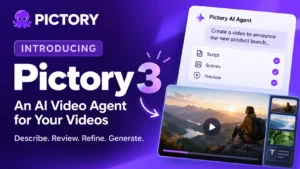
Pictory also launched an MCP Server in 2025, which lets AI assistants orchestrate Pictory’s video creation pipeline through natural language without requiring direct API knowledge. You can describe the video you want and an AI agent handles the production steps automatically. InVideo has nothing equivalent.
API AND INTEGRATIONS: QUICK COMPARISON
| Feature | Pictory | InVideo |
|---|---|---|
| API access | ✓ Full developer API: text, URL, PPT, video summarisation, captions | ⚠ Limited API |
| No-code automation | ✓ Zapier + Make integrations | ✓ Zapier integration |
| MCP / AI agent support | ✓ MCP Server: orchestrate via AI assistants | ✗ Not available |
| Brand Kit in API | ✓ Brand Kit API included | ✗ Not available |
| Scale | Millions of videos/month via parallel processing | Not documented at enterprise scale |
| Compliance | SOC 2, GDPR, ISO 27001 | GDPR |
| Interactive hosting (Pictory Central) | ✓ Quizzes, CTAs, chapters, SCORM (Teams/Enterprise) | ✗ Not available |
✓ GDPR Compliant
✓ ISO 27001 Certified
Does Pictory Work for Teams?
Pictory’s Teams plan is built for content teams and agencies. It supports three or more users with shared brand kits, shared media libraries, and 1,800 video minutes per month. Teams can collaborate on projects, review work, and maintain consistent branding across all output without each person managing separate accounts.
For a marketing team that needs to keep brand standards tight across multiple content creators, the Teams plan removes a lot of coordination friction. For agencies managing video output for several clients, the per-user brand kit setup means each client’s assets stay organised and accessible. The enterprise plan scales further for larger organisations with custom limits and dedicated support.
Which Tool Is Right for You?
Pictory is the stronger choice if your primary workflow involves turning existing content into video. If you’re a marketer repurposing blog posts, a podcaster creating social clips from episode recordings, an educator converting lecture notes or webinars into video summaries, or a content team that needs to produce a consistent volume of on-brand video without a dedicated editor on staff, Pictory’s automation saves significant time every week.
Pictory is less suited to creators who need cinematic control over every visual element, brands building complex multi-scene ads with custom transitions, or teams that rely heavily on AI-generated footage rather than stock clips. Pictory’s editor is intentionally streamlined. That’s a deliberate trade-off, not a limitation.
InVideo fits creators who enjoy the editing process and want a full-featured studio. Its template library is extensive, its AI generation capabilities run deep at higher tiers, and the platform handles original video creation well. For marketers who need a polished 60-second Instagram ad built from scratch, InVideo’s creative range gives you more room. The trade-off is time: InVideo consistently requires more manual effort per video than Pictory.
Looking for an InVideo Alternative?
If you’ve been using InVideo and find yourself spending too much time in the editor, rebuilding brand styles from scratch, or losing AI generation minutes before the month resets, Pictory solves all three.
Pictory is purpose-built for teams that already have content and need it in video form fast. Paste a blog URL, upload a recording, or drop in a PowerPoint, and Pictory handles the scene structure, stock footage, captions, and voiceover automatically. Your brand kit applies across every video without manual re-styling. And unused AI credits roll over month to month, so a quiet week doesn’t cost you your generation budget.
For content marketers, L&D teams, and creators who publish regularly, the difference in output per hour is significant. The URL to Video workflow turns any blog post into a captioned, narrated video in minutes. The step-by-step Academy guide walks you through the full process. Try Pictory free for 14 days to see how it compares to your current InVideo workflow.
TRY PICTORY
Turn your content into video in minutes
Paste a blog post, upload a recording, or start from a script. Pictory handles the rest. No video editing experience needed.
Our Verdict
For most content marketers, social media managers, educators, and solo creators who need to publish video consistently without a dedicated production team, Pictory is the more practical choice. The repurposing workflows are unmatched, the automation cuts per-video effort, and the Brand Kit system keeps output consistent at scale. The Professional plan at $35 per month covers a serious publishing volume, and the 14-day trial gives you enough time to run your real workflows through it before committing.
The clearest limitation is editorial flexibility. Pictory’s scene-based editor isn’t the right tool for creators who want to build bespoke videos with custom motion design, complex transitions, or AI-generated cinematic footage. If that’s your primary output, InVideo’s Max or Generative plans are worth a look. Some teams run both: Pictory for bulk content repurposing, InVideo for campaign-specific creative work.
If you’re on the fence, start with Pictory’s free trial and put your most common workflow through it. Convert a blog post, upload an audio file, try a PPT. If the output quality works for your content, you’ll know within the first few videos whether the automation model fits how you work.
FAQ: Pictory vs InVideo
Is Pictory better than InVideo for repurposing blog posts?
Yes, Pictory is the stronger tool for turning blog posts and articles into video. Paste a URL and Pictory extracts the key sentences, matches stock footage, adds captions, and generates a voiceover. InVideo creates a new script inspired by your input rather than pulling directly from the source, which means key points can be missed or reworded.
Can I use Pictory and InVideo for free?
Pictory offers a 14-day free trial with full feature access and watermarked exports. InVideo has a permanent free plan that includes 10 AI generation minutes per week and four watermarked exports per week. Neither free option works for regular professional publishing, but InVideo’s free plan gives you more time to evaluate the platform before committing.
Which AI video tool is better for social media content?
It depends on your workflow. Pictory is faster for turning existing content, such as blog posts or podcast recordings, into short social clips with accurate captions. InVideo’s template library is larger and better suited to creating social ads or branded short-form content from scratch. Both tools support vertical and square formats for Instagram, TikTok, and YouTube Shorts.
Does Pictory support team collaboration?
Yes. Pictory’s Teams plan supports three or more users with shared brand kits, shared media libraries, and 1,800 video minutes per month. It’s built for content teams and agencies that need multiple people working on video production under consistent brand standards. An enterprise plan with custom limits is also available.
How does Pictory compare to InVideo on pricing?
Both tools start at around $19 to $25 per month on annual billing. Pictory’s Professional plan at $35 per month includes ElevenLabs voiceovers, Getty and Storyblocks footage, and 600 video minutes. InVideo’s Max plan at around $48 per month on annual billing adds 4K export and voice cloning. For high-volume content repurposing, Pictory’s Professional plan offers strong value. For creative video production at higher quality tiers, InVideo’s Max plan is competitive.